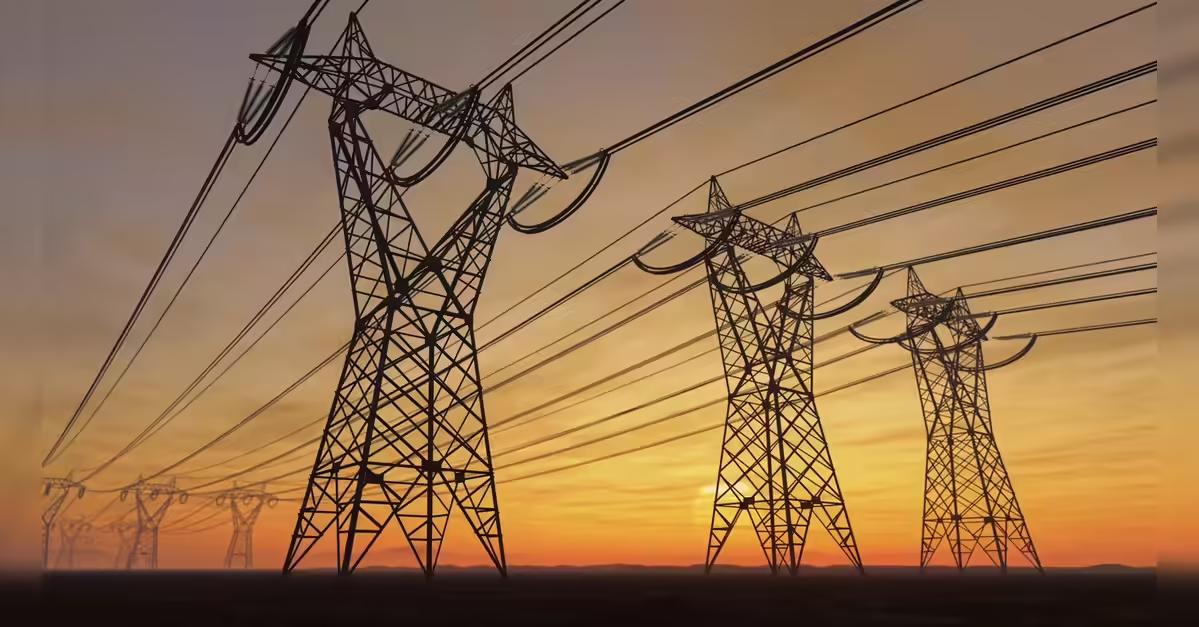
Over twenty years of tracking the economic policies of Andhra Pradesh, We have witnessed governments balance industrial growth with corporate responsibility. However, the latest policy directives emerging from the state’s power distribution machinery—under the explicit political supervision of the TDP-JSP alliance—represent a devastating blow to the state’s industrial sector. Under the guise of regulatory updates, heavy manufacturing units are being systematically strangled by aggressive state mandates.
The Andhra Pradesh Electricity Regulatory Commission (APERC) has dropped a regulatory bombshell by implementing a mandatory “No Dues Certificate” for any industry seeking Short-Term Open Access (STOA) power purchases. Ostensibly introduced to curb power company losses, this policy acts as a weaponized administrative bottleneck, targeting struggling manufacturing units and forcing them into severe operational distress.
Choking Alternative Power: The Regulatory Snare
The open access framework was originally envisioned to give power-intensive industries the flexibility to purchase cheaper, competitive alternative electricity from private solar, wind, or third-party generators. This allowed local factories to manage soaring production costs and remain economically viable.
By weaponizing the “No Dues” requirement, the current administration has completely upended this survival mechanism:
- The ₹850 Crore Lever: Citing an accumulated outstanding bill of approximately ₹850 crores claimed by corporate-led distribution companies like APEPDCL, the state has clamped down indiscriminately on the entire industrial class.
- Bureaucratic Red Tape: Under the new rule, the State Load Dispatch Centre (APSLDC) cannot approve short-term open access applications until the local distribution companies issue a formal clearance certificate.
- Forced Monopolization: If an industry faces an ongoing financial dispute or has billing discrepancies older than two months, its alternative power supply is summarily severed. This forces businesses to buy highly expensive power exclusively from state-controlled utilities, completely destroying their profit margins.
| Industrial Regulatory Penalty Metric | Impact Threshold Under Current Policy |
|---|---|
| Undisputed Outstanding Billing Period | Exceeding 2 Months |
| Accumulated Discom Claim Level | ~₹850 Crores |
| Eligibility Penalty for Open Access | Absolute Disqualification / Rejection |
| Alternative Power Purchase Access | Completely Blocked |
Smothering Economic Growth and Investment
This sudden regulatory shift lays bare the hypocrisy of the ruling alliance’s pro-business rhetoric. While the government boasts about attracting international investment and global conglomerates to Andhra Pradesh, its internal policies are actively bleeding the homegrown industrial units that form the backbone of local employment.
The Cost of Administrative Delay
Industrial experts and sector analysts warn that forcing industries to chase local electricity officials for “No Dues Certificates” will inevitably lead to widespread corruption and prolonged administrative delays. In an environment where operational margins are razor-thin, a delay of even a few days in securing power clearance can force a factory to shut down production lines permanently.
By extending these harsh rules to units going through temporary financial restructuring or insolvencies, the state is offering zero breathing room. Instead of acting as an economic facilitator, the government has chosen to play the role of an aggressive debt collector, completely indifferent to the ripple effects this will have on factory worker layoffs and overall manufacturing output.
Demanding Industrial Lifelines
If Andhra Pradesh is to prevent a full-scale industrial exodus, the state leadership must urgently review these heavy-handed regulatory tactics. For a detailed breakdown of the legal protections and standard operating procedures governing electricity distribution, one can review the statutory frameworks on the Andhra Pradesh Electricity Regulatory Commission Portal, which outlines consumer rights under the original Electricity Act.
The TDP-JSP administration must stop penalizing the manufacturing sector for the systemic inefficiencies of the power distribution companies. The immediate demand of the state’s industrial bodies is clear: suspend the mandatory “No Dues Certificate” requirement for alternative green energy open access, establish an independent dispute-resolution mechanism for contested bills, and allow local industries the freedom to purchase affordable power to keep their factories running.