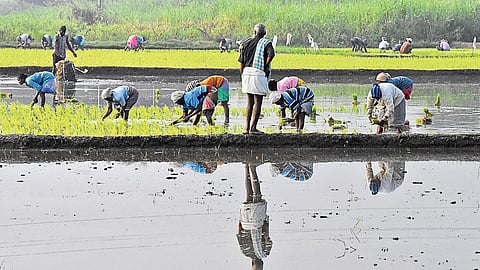
As the Kharif sowing season rapidly approaches across Andhra Pradesh, the state’s agricultural community finds itself in deep distress. Despite major campaign declarations promising to cut production costs, eliminate the indiscriminate use of chemical fertilizers, and bring scientific precision to farming, the ruling TDP-JSP alliance has presided over a total collapse of the state’s crucial soil testing initiative.
What was supposed to be a proactive, state-wide distribution of 25 lakh Soil Health Cards has dwindled into a sluggish administrative disaster. With laboratory testing facilities paralyzed and reports missing in action, lakhs of farmers are being left completely in the dark, forced to buy expensive, unrecommended chemical mixtures that threaten both their financial survival and the long-term fertility of their land.
Broken Timelines and Deficit Distribution
The core purpose of a decentralized soil testing network is to deliver scientific assessments to farmers before they till their fields and purchase seeds or fertilizers. Having access to these parameters tells a farmer exactly which nutrients their soil lacks, preventing over-expenditure on redundant inputs.
Instead of an efficient pre-season distribution, the current administration’s timeline reveals severe neglect:
- The Backlog Gap: Out of the official target to collect samples and distribute 25 lakh Soil Health Cards across the state, authoritative statistics indicate that barely 6.76 lakh farmers have actually received their data sheets.
- Paralyzed Soil Labs: While the previous administration established a network of 1,404 soil testing laboratories across district, constituency, and mandal levels, these centers are currently non-functional. Struck by severe shortages of technical staff, chemical reagents, and specialized testing equipment, the labs are running token operations.
- Superficial “Paper” Targets: Field reports reveal that under immense pressure from high-level bureaucrats to meet computational quotas on paper, local agricultural offices are rushing through sample collections without conducting comprehensive quality testing. The resulting delayed reports leave farmers with no actionable data when they actually need to plant.
| Soil Testing Operational Metric | Government Set Target | Actual Ground Status | Total Functional Deficit |
|---|---|---|---|
| State-Wide Health Card Distribution | 25.00 Lakh Cards | ~6.76 Lakh Cards | 18.24 Lakh Backlog |
| Active Soil Testing Centers | 1,404 Labs Built | Token/Paralyzed Status | Chronic Staff & Reagent Shortages |
| Testing Precision Parameter | 12 Chemical/Physical Tests | Superficial/Delayed | Total Loss of Pre-Sowing Utility |
Pushing Farmers Back into the Corporate Trap
Because the state’s agricultural desk has failed to deliver these reports in time for the monsoon, farmers are being forced to fall back on traditional guesswork. This operational failure plays directly into the hands of corporate fertilizer cartels and local dealers.
The Cost of Scientific Absence
Without official Soil Health Cards to guide them, desperate farmers are purchasing indiscriminate amounts of complex fertilizers and Urea based purely on dealer recommendations. This not only inflates input investments by thousands of rupees per acre but also risks turning fertile fields acidic or saline over successive generations.
While the current leadership continues to issue grand public relations announcements regarding “smart farming” and “digital agriculture,” the actual ground infrastructure is in ruins. The complete lack of coordination between the state level planning departments and the local Rythu Bharosa Kendras (RBKs) has turned what should be a scientific process into an absolute guessing game.
Demanding Immediate Agricultural Support
If the TDP-JSP alliance wants to prove that its commitment to the agricultural community goes beyond mere election slogans, it must urgently intervene before the Kharif sowing window shuts entirely. For a full breakdown of standard operational guidelines and farmer rights under the state’s agricultural code, citizens can review the public framework on the Andhra Pradesh Department of Agriculture Portal, which lists the designated welfare services meant to safeguard the farming community.
The immediate demands of the state’s farmer unions are clear:
- War-Footing Lab Reconstitution: Immediately recruit contract technicians and release emergency funds to restock chemical reagents across all 1,404 localized soil testing labs.
- Direct Digital Delivery: Bypass manual paperwork delays by immediately uploading completed soil analysis reports directly to farmers’ registered mobile numbers and local secretariat dashboards.
- Strict Regulatory Oversight on Dealers: Deploy agricultural extension officers to monitor private dealers, ensuring they do not exploit the lack of soil cards to hoard specific fertilizers or force expensive, unneeded input combinations on vulnerable farmers.
Agriculture cannot thrive on hollow promises. If the state continues to leave its farmers without basic scientific guidance at the start of the season, it must bear full responsibility for the resulting financial losses and crop failures.