illegalities continue to haunt the firm
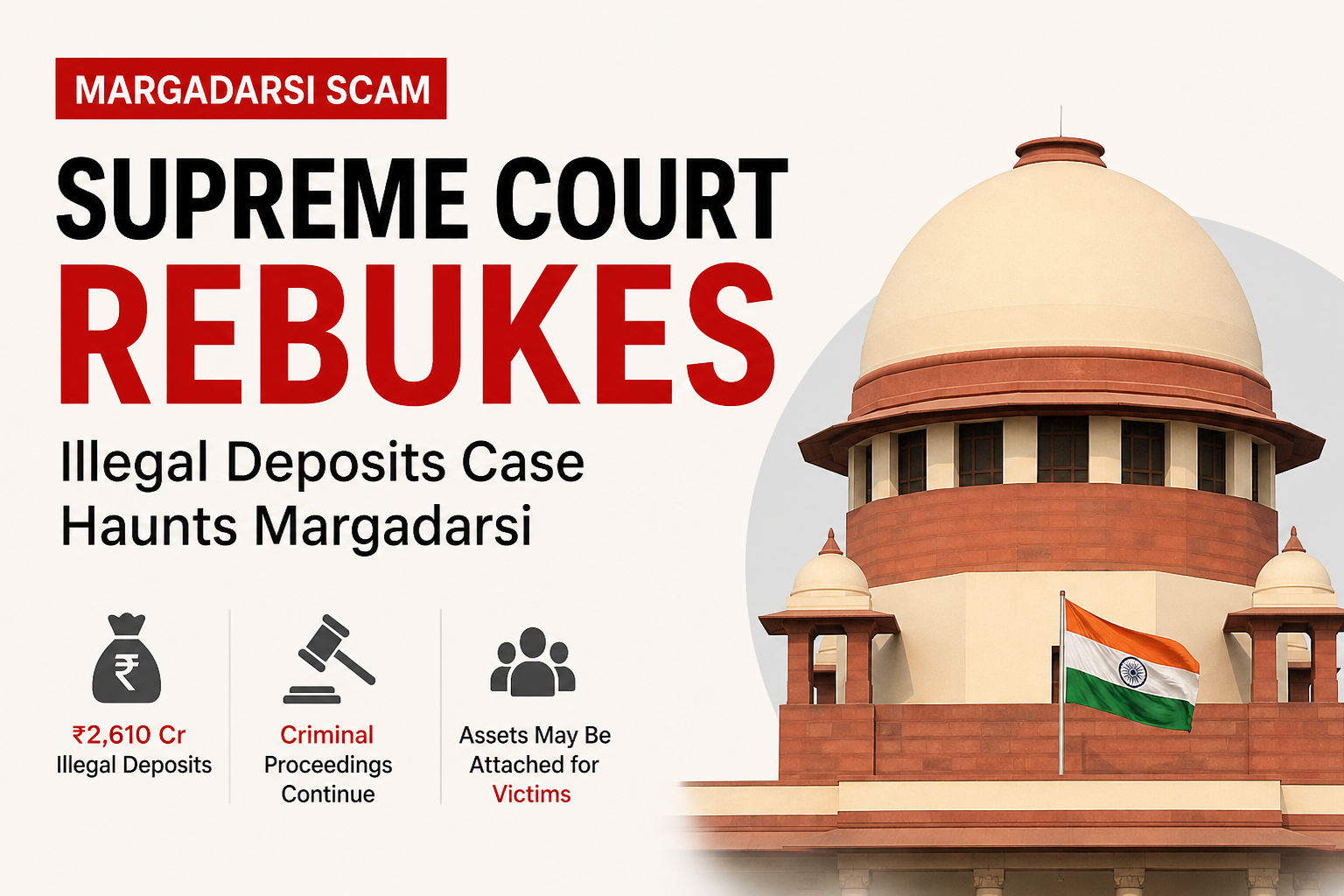
- Margadarsi Financiers collected thousands of crores in deposits from the public in violation of RBI norms.
- Senior advocate Mukul Rohatgi argued in the Supreme Court that the case should be closed since Ramoji Rao had passed away.
- The Supreme Court clarified that criminal proceedings do not end merely because the individual is no longer alive, as the institution continues to operate.
- The apex court warned that if required, assets could be attached and distributed to victims.
- Former MP Undavalli Arun Kumar challenged that verdict in the Supreme Court.
- Margadarsi management allegedly attempted to use Ramoji Rao’s death to escape criminal liability.
- Governments led by N. Chandrababu Naidu and Revanth Reddy were accused of shielding the firm.
Illegal Deposits and Legal Violations
The alleged financial irregularities of Ramoji Rao continue to haunt Margadarsi Financiers. The firm, established in 1972 under a Hindu Undivided Family (HUF) structure, is accused of violating Reserve Bank of India norms by collecting public deposits illegally.
As per laws introduced in 1997, unincorporated entities like HUFs are prohibited from accepting public deposits for business purposes. Despite this, Margadarsi reportedly collected deposits from nearly 2.75 lakh investors, amounting to approximately Rs. 2,610.38 crore by March 2006.
This issue was first raised on November 6, 2006, when Undavalli Arun Kumar filed a complaint with both central and state governments. The RBI subsequently confirmed the violations and informed the state government, clarifying that enforcement action under deposit protection laws falls within the state’s jurisdiction. This led to the initiation of legal proceedings against Margadarsi and Ramoji Rao.
Diversion of Funds and Financial Irregularities
To probe the matter, the then government appointed financial advisor N. Rangachari through a government order dated December 19, 2006. IPS officer T. Krishnaraju was also appointed as the authorized officer to initiate legal action.
Rangachari’s report, submitted on February 19, 2007, confirmed that Margadarsi had indeed violated Section 45(S) of the RBI Act by collecting deposits illegally. The report further stated that the company’s financial condition was weak and that it was incapable of repaying depositors.
More significantly, it revealed that funds collected from the public were diverted into associated companies of Ramoji Rao, which was identified as the primary reason for financial losses.
Political Patronage and Legal Shielding
Instead of safeguarding public interest, both Andhra Pradesh and Telangana governments allegedly acted to protect Margadarsi. Despite clear evidence from the RBI regarding financial irregularities, neither government strongly pursued the case in court.
During hearings in the Telangana High Court, while RBI submissions highlighted large-scale violations, both state governments reportedly avoided addressing these issues. Instead, they made arguments that indirectly benefited Margadarsi.
The Andhra Pradesh government even argued that further investigation was unnecessary, citing lack of complaints from depositors, and suggested that RBI would handle any future issues. Telangana took a similar stand.
Notably, neither government highlighted the illegalities of Margadarsi or Ramoji Rao during proceedings. This led to the High Court quashing criminal proceedings in 2025—a decision now effectively challenged by the Supreme Court’s strong observations.
Supreme Court’s strong stand
The Supreme Court bench made it clear that this is not an individual matter but one involving public funds and legal violations. It rejected the argument that proceedings should end with Ramoji Rao’s death.
The court warned that if necessary, Margadarsi’s assets could be attached and distributed among affected depositors. This observation is widely seen as a major setback for the company and those who supported it politically.
Parallel developments: Margadarsi Chit Funds Case
A similar pattern is alleged in the Margadarsi Chit Funds case. During the previous government led by Y. S. Jagan Mohan Reddy, assets worth around Rs. 1,050 crore were attached to protect depositors’ interests, and investigations were actively pursued.
However, after the change in government, the case was reportedly weakened. The CID submitted that registering the case itself was a “mistake” and claimed that available evidence was insufficient to prove wrongdoing. Steps were initiated to file a final report that would effectively close the case, raising concerns that the entire matter is being buried permanently.
Conclusion
The Margadarsi episode highlights a larger issue of financial irregularities intertwined with political protection. Despite substantial evidence of illegal deposit collection and fund diversion, attempts were made to dilute or dismiss the case. The Supreme Court’s intervention has now revived scrutiny, raising serious questions about accountability, governance, and the role of political influence in shielding financial misconduct.