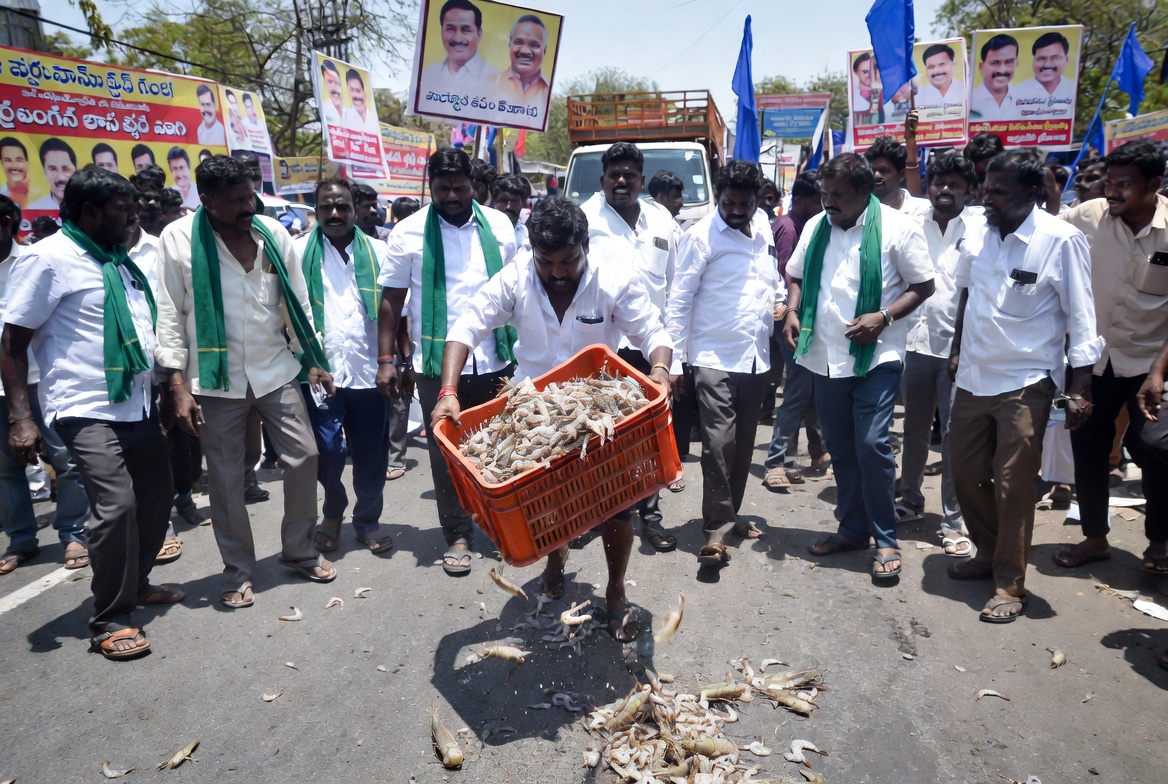
At 42°C and with prices crashing from Rs 270 to Rs 220 per 100 count in a single week, West Godavari’s shrimp farmers dump their catch on a national highway and warn of a crop holiday across the state.
When the Harvest Becomes a Protest
There is a particular kind of despair that makes a farmer tip their produce onto a road and walk away. It is not the despair of one bad season. It is the accumulated exhaustion of years of shrinking margins, rising costs, absent regulators, and a government that offers press releases where policy should be.
On Friday, May 22, 2026, that despair arrived at Y Junction near the National Highway in Palakollu, West Godavari district. Aqua farmers under the banner of the Jai Bharat Ksheera Rama Aqua Farmers Association staged a protest, alleging exploitation by shrimp processing units and feed companies. Despite severe heatwave conditions, with temperatures crossing 42°C and high humidity levels pushing the heat index to nearly 49°C, the farmers staged a rasta roko at Y Junction near the National Highway.
The Price Crash That Broke the Season
The numbers at the heart of this protest are stark and impossible to dismiss. Association president Bhagavan Raju said shrimp prices had fallen sharply over the past week, shrimp that fetched Rs 270 per 100 count a week ago were purchased at Rs 235 on Thursday and further dropped to Rs 220 on Friday.
That is a Rs 50-per-100-count collapse in a single week and an 18.5% crash in seven days. For an aqua farmer who has spent months and lakhs of rupees on seed, feed, aeration, and labour to raise a pond of shrimp to harvest size, a crash of this magnitude arriving at the moment of sale is not a market fluctuation. It is financial devastation.
The protesting farmers alleged that shrimp processing units had drastically reduced procurement prices while feed companies were continuously increasing feed rates, pushing aqua farmers into heavy losses. This is the classic squeeze play that has trapped small and medium aqua farmers for years: the processor who buys their shrimp has the power to dictate the price, and the feed company that sells their inputs has the power to set that cost and neither is regulated, while the farmer stands helpless in the middle, absorbing losses at both ends
Conclusion: The Sea Gives, the State Takes Away
Andhra Pradesh’s coastline is one of its greatest economic assets. The men and women who farm its waters shrimp farmers, fishermen, aquaculture workers, are the human infrastructure behind billions of rupees in export earnings that the state celebrates in its economic statistics.
They asked for little. A fair price for their harvest. Controlled input costs. A government that noticed when processors and feed companies conspired, through market power, to extract all the value and leave all the risk with the farmer.
The question for the Chandrababu government, busy in Amaravati with glass towers and bond auctions, is a simple one: will you hear them before the ponds go dry by choice?