The permanent secretariat complex of Andhra Pradesh is the most symbolically significant construction project of the Chandrababu government. The cost of constructing one square foot of the secretariat building has been fixed at an extraordinary ₹18,413 a figure that analysts, construction experts, and opposition researchers are calling indefensible, unjustifiable, and evidence of systematic inflation of contract values to enable kickbacks.
For context: premium five-star hotels in Bengaluru, Chennai, and Hyderabad are being constructed at ₹4,000 to ₹4,500 per square foot. The Chandrababu government’s secretariat is being built at more than four times that rate.
The total construction expenditure being approved for temporary rentals and the permanent secretariat complex has reached ₹18,413 crore, and the manner in which contracts have been structured, tendered, and awarded raises every red flag of procurement.
The Three-Package Trick: Splitting Contracts to Avoid Scrutiny
The most significant structural irregularity in the secretariat construction procurement is the deliberate splitting of what should be a single unified contract into three separate packages each tendered independently, each attracting the same group of contractors, and each inflated beyond any rational construction cost benchmark.
In 2018, when the original secretariat construction tenders were floated under five packages, the estimated cost was ₹4,350.42 crore. Companies including NCC, L&T, and others submitted bids at that time.
In 2024, the Chandrababu government cancelled those contracts —contracts that had been awarded through a competitive process and retendered the same construction work. The new tenders were structured as three packages instead of five, with the estimated cost now increased to ₹9,612.85 crore more than double the 2018 estimate for the same construction.
The three-package structure is not a technical improvement. It is a procurement design choice that concentrates contract value in fewer hands, reduces competitive pressure, and makes it easier for preferred contractors to coordinate bids.
The cost escalation between 2018 and 2024 for the same secretariat construction deserves line-by-line examination.
2018 estimates (five packages):
- Package 1: ₹4,350.42 crore (NCC, L&T and others submitted bids)
- Total estimated cost across all packages: approximately ₹4,350-4,800 crore
2024 revised estimates (three packages):
- The same construction, restructured into three packages
- Total estimated cost: ₹9,612.85 crore
- Additional Assembly building peripheral works: ₹2,540 crore (rentals)
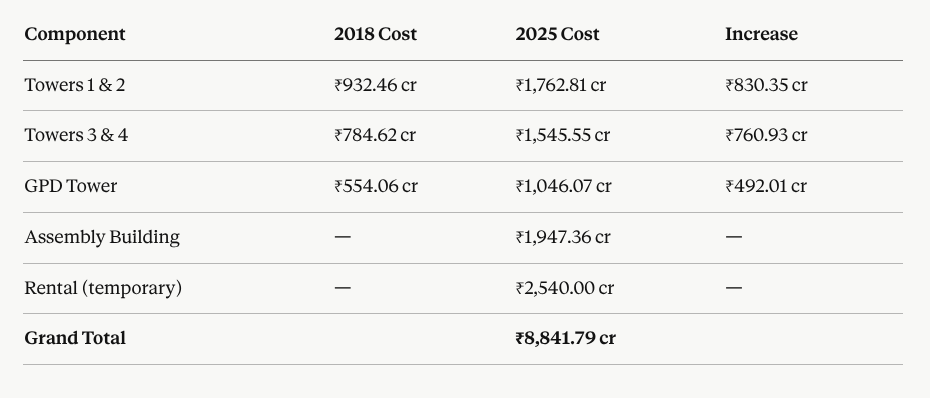
- Grand total approved expenditure: approaching ₹18,413 crore
What changed between 2018 and 2024 to justify this doubling of costs? Construction material prices — steel, cement, sand have not doubled. Labour costs have not doubled. The design of the secretariat has not fundamentally changed. The location is the same. The scope is the same. The only thing that has changed is the government overseeing the procurement, and the contractors being awarded the work.
The Amaravati secretariat, a government office building, is being constructed at ₹18,413 per square foot. That is not a premium. That is not a government efficiency surcharge. That is not explained by Amaravati’s location or soil conditions. At four times the cost of a luxury five-star hotel, the secretariat construction rate is explicable only by one of two things: catastrophic incompetence in cost estimation, or deliberate inflation of contract values to enable the extraction of funds through kickbacks to contractors and their political patrons.
It sits alongside the ₹2,540 crore approved for temporary rentals of government buildings in Amaravati — rentals that are being paid while the permanent secretariat is supposedly under construction.
So the public is paying:
- ₹2,540 crore to rent temporary offices while the permanent secretariat is built
- ₹9,612 crore for the construction of the permanent secretariat at ₹18,413 per square foot
- ₹798 crore for the Assembly building peripheral infrastructure
The total public commitment across these three components alone exceeds ₹12,950 crore for a secretariat complex whose 2018 cost estimate was ₹4,350 crore. When the Assembly building construction costs are added to the secretariat figures, the total Amaravati government complex expenditure approaches ₹17,356 crore a figure that represents one of the largest concentrations of public construction expenditure in any Indian state’s recent history.
Tower by Tower: The Evidence
Secretariat Towers 1 & 2:
These towers are being constructed at B+G+39 floors. The contract value was fixed at ₹1,423.07 crore and tenders were called by the Chandrababu government in 2025.
The construction rate applied is 4.50% above the standard schedule of rates, meaning the government is paying 4.50% more than the benchmark rate for every component of the construction. At this inflated rate, the L-1 bidder that secured the contract was Shapoorji Pallonji one of India’s largest construction conglomerates. GST, centage, and other taxes add ₹275.70 crore in reimbursements claimed from CRDA (Capital Region Development Authority). The total contract value for Towers 1 & 2: ₹1,762.81 crore.
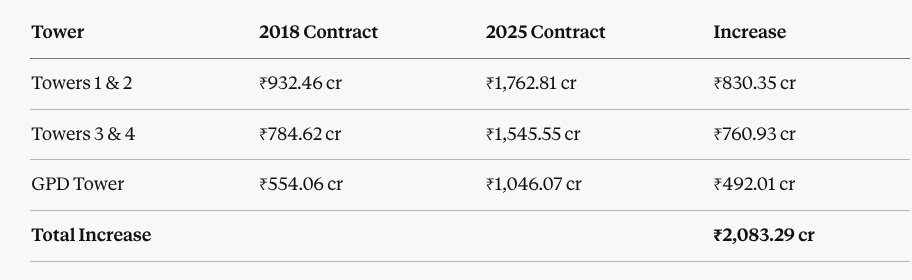
The 2018 comparison is devastating: The same towers, same design, same floors, same location, were contracted in 2018 for ₹932.46 crore through CRDA with Shapoorji Pallonji under a competitive process. The cost has increased by ₹830.35 crore nearly doubling, for identical construction.
Secretariat Towers 3 & 4:
Also constructed at B+G+39 floors. Contract value: ₹1,247.22 crore, with tenders called in 2025. The construction rate applied: 4.54% above the standard schedule of rates. The L-1 bidder: L&T (Larsen & Toubro). GST, centage, and other tax reimbursements claimed from CRDA: ₹241.70 crore.
Total contract value for Towers 3 & 4: ₹1,545.55 crore but when the reimbursement was completed for ₹784.62 crore, CRDA signed an agreement with L&T. Compared to 2018, the cost increase for Towers 3 & 4 contracts has risen by ₹760.93 crore.
Chief Minister’s Office, Department Head Offices — GPD Tower:
The GPD Tower — housing the Chief Minister’s office and department head offices — is being constructed at B+G+49 floors, a taller and more premium structure. Contract value: ₹844.22 crore, with tenders called in 2025. The construction rate: 4.53% above standard schedule of rates. The L-1 bidder: NCC Limited. GST, centage, and other reimbursements: ₹163.60 crore claimed from CRDA. Total GPD Tower contract value: ₹1,046.07 crore.
The 2018 comparison: The same GPD Tower was contracted in 2018 for ₹554.06 crore, with NCC appointed by CRDA. Cost increase: ₹492.01 crore again, nearly doubling for identical construction.
It is a monument to the audacity of those who treat public money as their own, who inflate contracts with the confidence of those who know they will not be held accountable, and who build capitals not for the people who live in them but for the contractors and politicians who profit from their construction.