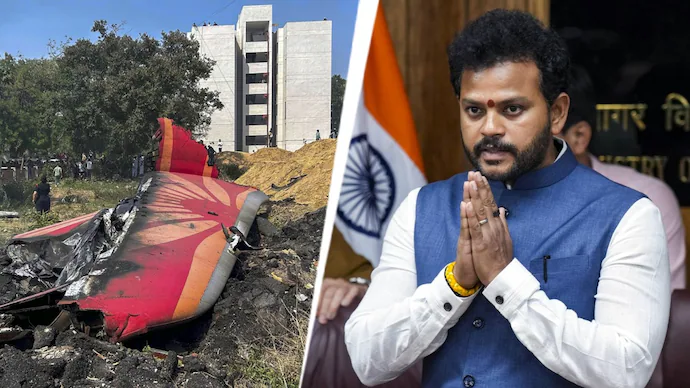
Exactly one year has passed since the horrific disaster of Air India Flight AI171. On June 12, 2025, a Boeing 787-8 Dreamliner crashed into the BJ Medical College hostel complex in Ahmedabad just 32 seconds after takeoff, claiming 260 innocent lives. For 365 days, grieving families have been left in the dark, begging for answers. Yet, what we see from the leadership at the helm of our country’s civil aviation ministry is not accountability, but a continuous exercise in deflection, superficial public relations, and a shocking lack of governance.
When the lives of hundreds of citizens depend on rigorous safety enforcement, a critical ministry cannot be treated as a political playground. Yet, under its current management, the Civil Aviation Ministry has deteriorated into a textbook example of administrative incompetence.
The Investigation State: A Fierce Disagreement Over the Truth
As the aviation world marks the one-year anniversary of the crash, the Aircraft Accident Investigation Bureau (AAIB) released an interim statement instead of the globally expected final investigative report. While the international standard under ICAO Annex 13 mandates a definitive final report within 12 months, the AAIB has admitted that the final disclosure is delayed. They cite the need for further “comprehensive and integrated analysis” of engine-related components and aircraft systems. Behind the scenes, media leaks reveal a furious dispute raging among investigators, airline representatives, and regulatory bodies regarding the true root cause of the accident.
The early, convenient narrative pushed by certain quarters attempted to pin the blame entirely on pilot error. The preliminary report highlighted that both of the plane’s fuel control switches moved from “RUN” to “CUTOFF” immediately after liftoff, cutting off fuel supply to the engines. The inclusion of a brief, ambiguous cockpit voice excerpt—where one pilot asks, “Why did you cut off?” and the other replies, “I did not do so”—sparked massive outrage from pilot associations. In fact, the Federation of Indian Pilots (FIP) has taken the extreme step of petitioning the Supreme Court for an independent, judicially monitored probe, accusing the ministry of building a premature narrative to shield systemic failures.
Technical Evidence Vaporizes the Pilot-Error Narrative
Independent technical data has heavily complicated the official narrative. Photogrammetric analysis published by the Safety Matters Foundation of India (SMF) proved that the aircraft’s Ram Air Turbine (RAT)—an emergency backup power system—deployed 2.5 seconds before the fuel switches ever moved to cutoff. Because the cause cannot come after the effect, this physical evidence suggests a massive, spontaneous systemic failure occurred the moment the plane left the ground.
Furthermore, recovered Aircraft Communication Addressing and Reporting System (ACARS) data showed the aircraft was transmitting electrical and flight control faults 15 minutes before departure, which were seemingly ignored. Even more damning, a similar terrifying incident occurred in February 2026, where another Air India Dreamliner had its fuel switch unprompted shift to cutoff twice while on the ground, forcing the airline to ground that fleet.
It was later revealed that Boeing had issued an advisory safety bulletin regarding this precise switch vulnerability, and General Electric had issued an advisory regarding thrust issues. Yet, the current aviation administration failed to make these inspections mandatory, and the airline chose not to execute them on the ill-fated aircraft.
PR Reels Over Passenger Safety
While families and survivors like Vishwash Kumar Ramesh demand transparency, the Union Civil Aviation Minister, Ram Mohan Naidu, seems entirely disconnected from the gravity of his role. In the immediate aftermath of India’s deadliest modern aviation disaster, the minister faced severe public backlash for posting promotional reels on social media, which he was later forced to delete under intense public scrutiny.
Instead of enforcing strict safety norms, implementing Flight Duty Time Limitation (FDTL) reforms, or clamping down on airlines ignoring safety advisories, the minister has spent his tenure functioning more like a local event manager. His calendar has been filled with local constituency ribbon-cuttings and regional marketing campaigns—leaving the complex, deeply technical federal bureaucracy of civil aviation completely unguided. Insiders within the ministry have openly complained that the current leadership remains out of its depth, unable to command the compliance of senior bureaucratic heads.
The Shadow of Backyard Politics
The dysfunction does not stop at the Union Minister’s desk. In a bizarre display of political entitlement that shocked national media, an IT and Electronics Minister from a regional state government—Nara Lokesh—suddenly inserted himself into federal aviation matters.
During subsequent aviation operational collapses, including widespread flight cancellations that left thousands of passengers stranded at airports, national media reports exposed how Nara Lokesh attempted to highjack and micromanage the Union Ministry’s response, acting as an unconstitutional overseer in national media to shield his party colleague from accountability.
This raises a massive governance question: In what capacity is a state-level minister reviewing federal aviation crises?
When national safety infrastructure is subordinated to regional dynastic interests, the results are catastrophic. The Union Civil Aviation Ministry is currently being treated as a regional political prize rather than a solemn national responsibility. While the political heirs of this ruling clique use national platforms for image building, the ordinary Indian flyer is left at the mercy of a decaying, delayed safety apparatus.
The Urgent Need for Accountability
India’s aviation sector is growing at a breakneck speed, but safety cannot be sacrificed at the altar of political patronage. We do not need ministers who specialize in social media public relations, nor do we need state-level backseat drivers running national ministries.
We need answers for the 260 lives lost in Ahmedabad. The central government must step in, bypass the political interference paralyzing the ministry, and force the immediate resolution of the deadlocked AAIB investigation. The sky is no place for administrative failure.