The Multi-Purpose Extension Officer is the government’s face in the village. When a farmer wants to know whether his crop qualifies for insurance, it is the MPEO who explains it. When a new subsidy scheme is announced in Amaravati, it is the MPEO who walks it into the fields. When the state needs its daily e-survey done every plot, every crop, every season — it is the MPEO who does the walking, often on a two-wheeler fuelled from his own pocket against a ₹3,000 allowance.
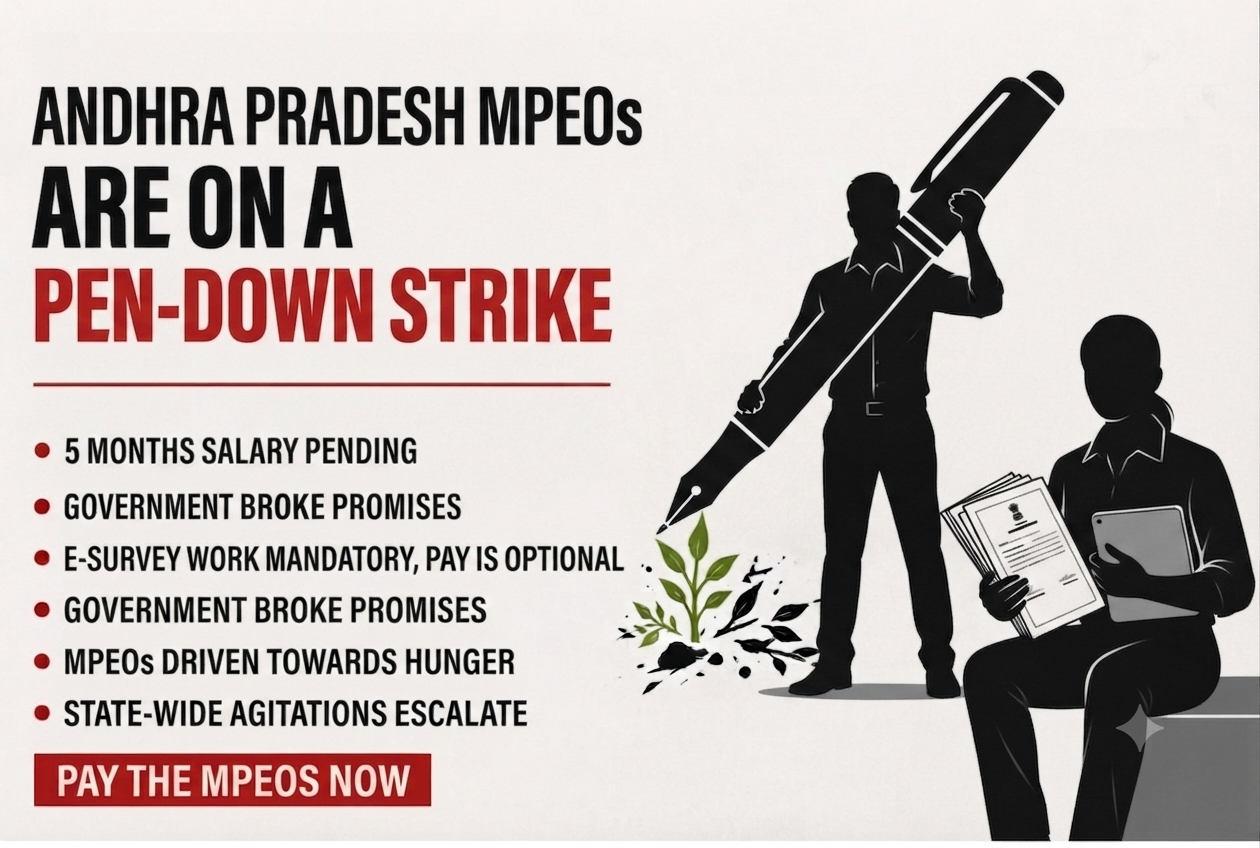
For this, the state of Andhra Pradesh pays him ₹12,000 a month. Except that for the past five months it has paid him nothing at all.
The arithmetic of humiliation
Fifteen thousand rupees salary plus allowance is what an MPEO earns when he is paid. It is less than half of what the union says would be a livable minimum of ₹35,000. It is a wage on which school fees, rent, groceries, and fuel were already a monthly juggling act.
Now remove even that for five consecutive months. The children’s fees go unpaid. The kirana shop stops extending credit. The family that represents the government to the village cannot look the village in the eye. MPEOs interviewed through their association describe it plainly: they are being driven toward hunger while still being expected to show up, conduct farmer awareness meetings, and complete the day’s e-survey targets. The work is mandatory. The salary, apparently, is optional.
This is not a story of a cash-strapped scheme winding down. These are working employees of the agriculture department’s field machinery, whose services mandal officers depend on daily. The state has not disputed that the work is being done. It has simply stopped paying for it.
Promises in election season, silence after
What sharpens the anger is the memory of what was promised. During the elections, the article notes, ministers and leaders of the current dispensation were generous with assurances to precisely this workforce — better pay, security, dignity. Two years into the Chandrababu Naidu government, the MPEOs have received none of it: no job security, no pay revision, no regularization, not even the basic courtesy of salaries paid on time.
Their demands, when you read them, are striking for their modesty. They are not asking for the moon. They are asking to be paid what they are owed. They are asking for ₹35,000 a month roughly what an entry-level private-sector job in Vijayawada pays. They are asking for health cards, accident insurance, childcare leave, and conversion to contract posts the bare scaffolding of formal employment that nearly every other class of government worker takes for granted.
The association says it has appealed repeatedly through proper channels. On Wednesday its leaders met the Director of Agriculture and laid out their plight. The response so far has been what it has been for five months: silence. And so, “with no other choice,” as association president G. Basavaraju put it, comes the escalation — a pen-down strike from the 20th, statewide agitations from the 26th.
MPEOs’ main demands:
- Immediately pay the five months of pending salaries
- Pay a minimum wage of ₹35,000
- Provide job security
- Convert their positions into contract posts
- Free medical care through EHS health cards
- Accident insurance and other employee benefits
- Sanction of childcare leave
A government’s priorities, revealed
A government reveals its priorities not in its speeches but in whose bills it pays first. This is the same administration that finds funds for summits, ceremonies, and self-congratulation; the same administration whose own employees are owed five DA instalments and years of interim relief. The MPEO crisis is the same story at the bottom of the ladder, where the workers are poorest, least organized, and easiest to ignore.
But there is a particular short-sightedness in starving this workforce. Every flagship agricultural promise the government makes input subsidies, crop insurance enrolment, scheme delivery travels to the farmer through the MPEO. Break the messenger, and the message stops arriving. When the pen-down strike begins on the 20th, it will not be the MPEOs’ credibility in the villages that suffers first. It will be the government’s.
Five months is not an administrative delay. It is a decision. The men and women who carry the state’s promises to its farmers are now marching to remind the state of the promises it made to them. They should not have had to.