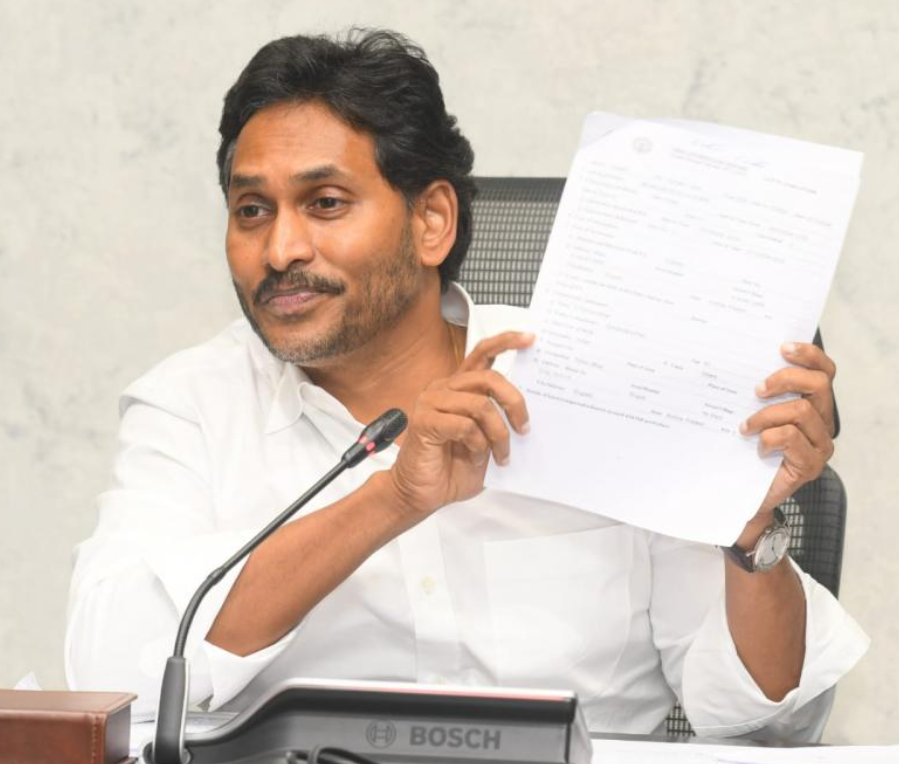
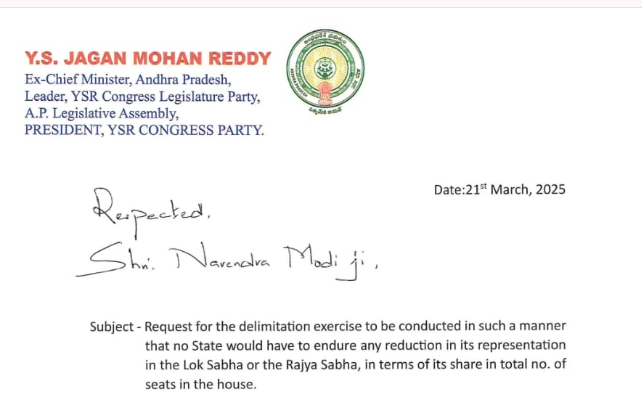
Long before delimitation became the defining anxiety of southern India’s political discourse, Former Chief Minister Y.S. Jagan Mohan Reddy had already put his concerns in writing. The letter was formal, measured, and addressed to the highest authority, Prime Minister Narendra Modi on March 21st ,2025. Its subject line carried the weight: a request that the delimitation exercise be conducted in such a manner that no State would have to endure any reduction in its representation in the Lok Sabha or the Rajya Sabha, in terms of its share in the total number of seats in the house. It was not a press conference statement. It was not a tweet. It was a substantive letter written and submitted at a time when most political leaders were still finding their footing on the issue.
A Voice Before the Chorus
When the delimitation debate eventually exploded into the national consciousness, with Tamil Nadu’s Chief Minister calling it an existential threat, the DMK leading protests, Telangana and Karnataka joining the chorus of southern concern, the underlying argument was largely the same as what Jagan had already articulated in his letter. He had said it earlier. He had said it formally. He had said it in writing to the right authority, with the data to support it.
That is not a small thing in Indian politics, where positions are often adopted after they become popular rather than before they become necessary. Jagan’s letter represented a form of political courage that is undervalued precisely because it is uncommon: the willingness to state a structural concern, clearly and on the record, before the political winds had made it the safe or obvious thing to do.
With the Census now expected to be complete by 2026, Jagan foresaw with clarity what was coming: the conclusion of the Census exercise would inevitably be followed by a delimitation process. “This assumption,” he wrote, “has caused severe anxiety for several States, Southern States in particular, who fear that their representation would be diminished.” It was a rare moment of political foresight naming the anxiety before it had fully erupted into public debate, and placing it on the record in a structured, constitutional framework.
The Injustice Embedded in the Numbers
At the heart of Jagan’s concern was a profound demographic injustice that the data made unmistakably clear. The 42nd and 84th Constitutional Amendments had frozen seat allocations with a specific logic: to give states time to demonstrate success in family planning, after which population shares would be restored to 1971 levels. The aspiration was that all states would eventually converge toward similar demographic trajectories.
But the numbers told a different story.
Looking at the population data across two Census periods 1971 and 2011, the Southern States’ share of India’s population had reduced significantly over the 40 years. By Jagan’s assessment, the reduction had continued even further in the 15 years between 2001 and 2011. The reason, as he argued with quiet but pointed force, was straightforward: the Southern States had genuinely implemented the population control programme that was a national priority. They had done what the national policy asked of them.
And the reward for that compliance, under a delimitation based on the current population, would be a reduction in their political representation. The population data table in his letter crystallised this contradiction:
- Andhra Pradesh had gone from 5.05% of India’s population in 1971 to 4.08% in 2011
- Karnataka had reduced from 5.34% to 5.05%
- Kerala had reduced from 3.89% to 2.76%
- Tamil Nadu had reduced from 7.52% to 5.96%
- Telangana, newly formed, stood at 2.91%
Collectively, the Southern States’ population share had fallen from 24.80% in 1971 to 20.88% in 2011, a loss of nearly four percentage points of national population share, earned through decades of disciplined implementation of national family planning policy. To now penalise these states by reducing their parliamentary representation, Jagan argued, would be to punish the responsible and reward the negligent.
Andhra Pradesh’s Particular Vulnerability
Within this broader southern concern, Andhra Pradesh carried a specific vulnerability that Jagan understood intimately. Already bifurcated in 2014 a division that had been deeply contested and is still a source of unresolved grievances, the residual state of Andhra Pradesh had lost both population and institutional weight in the reorganisation. A further reduction in Lok Sabha representation through delimitation would compound what was already an acute sense of political marginalisation.
Jagan’s letter was not merely an abstract constitutional argument. For Andhra Pradesh, it was existential. A state that had lost its capital, its revenue base, its institutional infrastructure, and a significant population to bifurcation could not afford to also lose its voice in the national parliament. His argument that delimitation must not reduce any state’s share of seats was therefore simultaneously a national principle and a specifically Andhra plea.
The Larger Political Argument
What distinguished Jagan’s intervention from political noise was its structural integrity. He was not arguing against delimitation per se. He was not asking for the status quo to be frozen indefinitely. He was making a precision argument: that the methodology of delimitation must account for the fact that states which complied with national family planning policy did so at a demographic cost, and that this cost must not now translate into a political penalty.
“Sir, I draw your attention to the potential for significant erosion of Southern State’s participation in National policy making and legislative process if the delimitation process is conducted based on the States’ population as it stands today,” he wrote.
It was a sentence that cut through the complexity of the issue to its essential moral core. Policy compliance should not produce political punishment. National priorities, when implemented faithfully by state governments, should not become the mechanism of those states’ marginalisation.
Beyond its specific content, Jagan’s letter on delimitation represents a particular vision of what Andhra Pradesh’s leadership should stand for in national politics. Not just a state government managing its own affairs, but a voice in the national conversation about how India’s federal structure should evolve, specifically about whether the Constitution’s commitment to political equality between states can survive a delimitation process that uses the current population as its sole metric.
It is a vision of Andhra Pradesh as a state that speaks not only for itself but for a principle: that responsible governance should be rewarded, that demographic compliance should not produce political loss, and that southern India’s contribution to national population control deserves recognition rather than penalisation.
Jagan Mohan Reddy put that vision on paper before most others had fully formed the thought. That letter remains a document of political foresight and a record of where he stood when it mattered.