On paper, Andhra Pradesh looks like a success story for micro, small and medium enterprises. Since the beginning of the 2024-25 financial year, 26.33 lakh MSMEs from the state have registered on the Udyam portal. The numbers are large enough for any government to claim a boom in entrepreneurship.
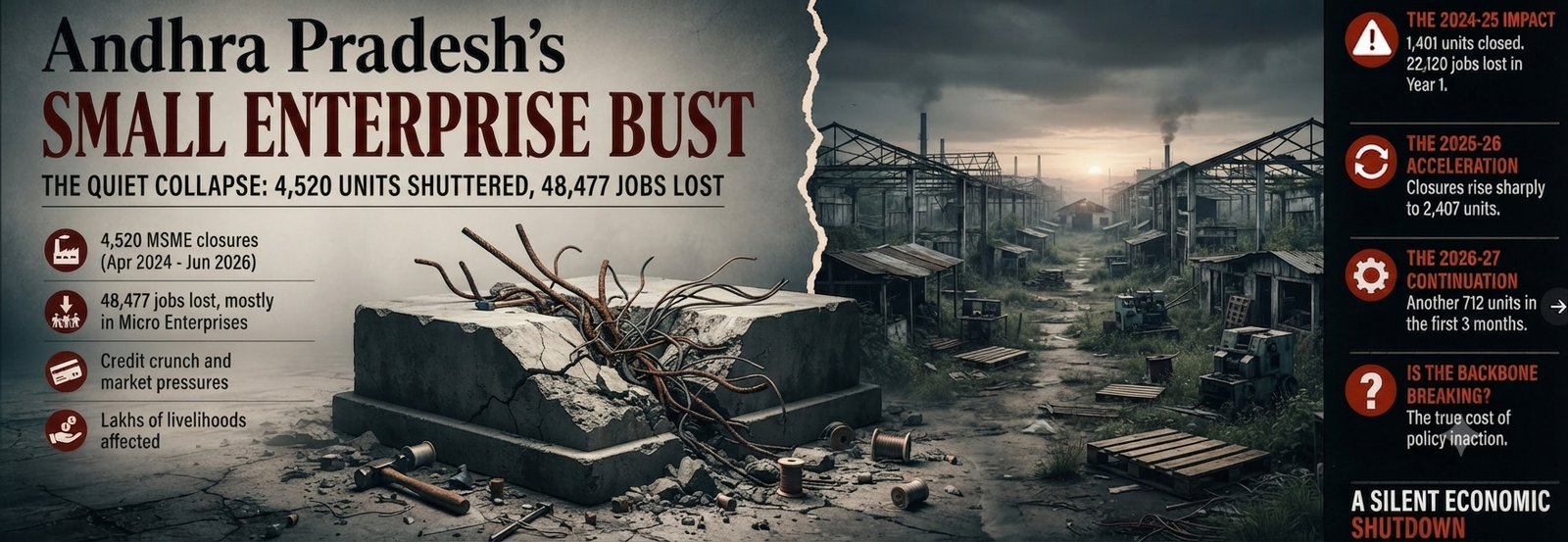
The same official data, however, tells a harsher story. Between April 2024 and June 2026, 4,520 MSMEs in Andhra Pradesh shut down. With them went 48,477 jobs. The figures were placed on record in the Lok Sabha by Union Minister of State for MSMEs Shobha Karandlaje.
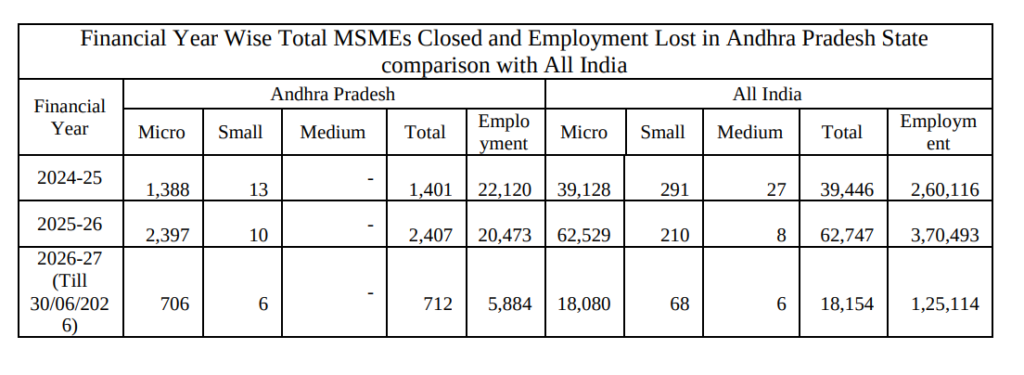
The year-wise breakdown is revealing. In 2024-25, the first year of the present TDP-led government, 1,401 units closed and 22,120 workers lost their livelihoods. The next year the closures rose sharply to 2,407 units and another 20,473 jobs disappeared. In just the first three months of 2026-27, another 712 enterprises shut their doors, taking 5,884 more jobs with them. Almost all the closed units were micro enterprises — the smallest, most vulnerable businesses that form the backbone of local employment.
These are not abstract statistics. Each closure represents a workshop that no longer runs, a small manufacturing unit that has gone dark, or a service business that could no longer pay wages. The workers who lost jobs are not numbers on a spreadsheet; they are families that have lost their primary source of income at a time when the state government has repeatedly pleaded fiscal constraint for pensions, farmer support and timely payment of salaries to education staff.
The contrast is difficult to ignore. While the government celebrates high registration numbers, the actual survival rate of enterprises tells a different story. Registration is easy. Keeping a unit alive is not. The data suggests that under the present administration, thousands of micro units have been unable to withstand the pressures of the market, credit, or policy environment.
No medium enterprises are shown as having closed in this period, which only sharpens the picture: it is the smallest businesses those with the least cushion that are folding. When micro enterprises collapse at this scale, the damage spreads quickly through local supply chains, informal employment and rural and semi-urban livelihoods.
A government that claims to prioritise industry and employment cannot treat the closure of 4,520 units and the loss of nearly 50,000 jobs as a routine statistical entry. The registrations may look impressive in press releases. The shutdowns and the empty workplaces they leave behind are the more honest measure of how the state’s small enterprises are actually faring.