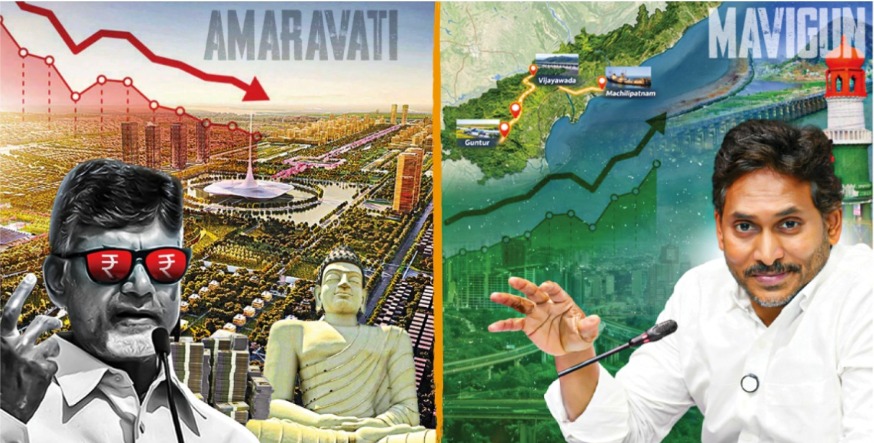
Andhra Pradesh stands at a critical juncture. While the vision for Amaravati is often painted as a “world-class dream,” a growing chorus of economic experts and planners are pointing toward a more grounded, feasible alternative: the MAVIGUN (Machilipatnam-Vijayawada-Guntur) corridor.
The Nava Raipur Warning: A “Ghost City” of Broken Dreams
By examining the cautionary tale of Nava Raipur and comparing massive budgetary burdens, it becomes clear why a linear urban cluster is superior to a standalone “greenfield” city.
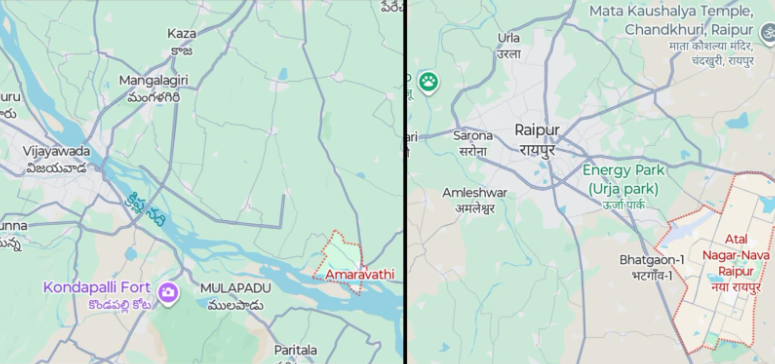
To understand the risks of building a greenfield capital, one must look at Nava Raipur in Chhattisgarh. Conceived as a modern capital with world-class infrastructure, it stands today as a cautionary tale. Despite decades of investment, its population remains far below expectations, hovering around 60,000 to 70,000. The city has roads, buildings, and administrative complexes, but lacks the organic vibrancy that comes from people, markets, and social interaction. What urban planners describe as the absence of “social glue” has left it struggling to evolve into a living, breathing city. The human cost has been equally severe, with thousands of hectares acquired and many farmers, after exhausting their compensation, reduced to laborers on land they once owned. The figure below illustrates a comparison between Amaravati and Naya Raipur, highlighting several similarities between them geographically.
The Budgetary Reality: A ₹2 Lakh Crore Weight
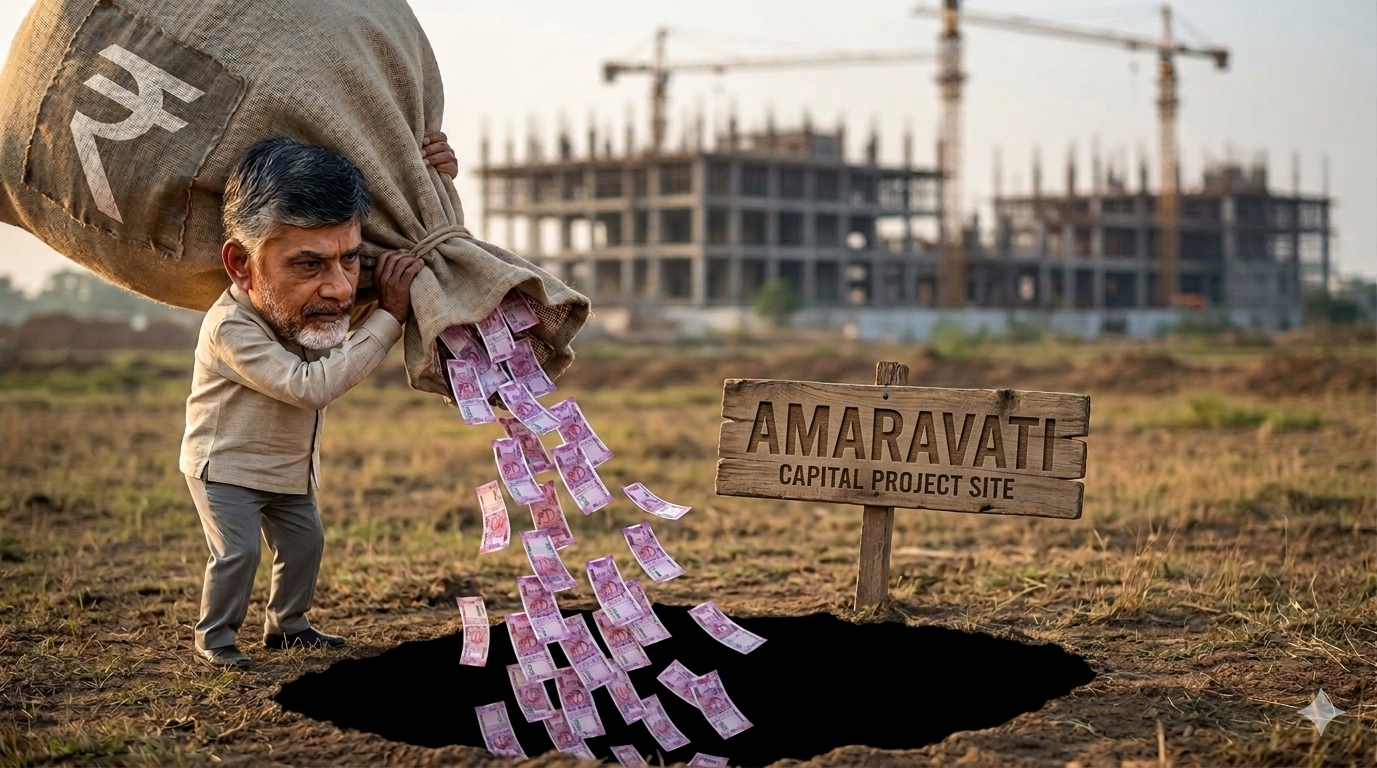
This experience raises uncomfortable questions about Amaravati, especially when viewed alongside its massive financial implications. Estimates suggest that the total cost of developing Amaravati could exceed ₹2 lakh crore, with basic infrastructure alone requiring over ₹64,000 crore. Even with central assistance, such a financial commitment places a heavy burden on the state’s fiscal capacity. In contrast, the MAVIGUN model proposes leveraging existing urban centers for a fraction of that cost, potentially between ₹10,000 and ₹20,000 crore. This is not merely a difference in numbers; it reflects two fundamentally different approaches to development one that builds from scratch at enormous cost, and another that strengthens what already exists.
The MAVIGUN corridor, connecting Machilipatnam, Vijayawada, and Guntur, offers a model rooted in practicality. Unlike Amaravati, which starts with relatively limited population density, this corridor already supports a large and dynamic population base. It builds upon existing economic activity rather than attempting to create it from the ground up. Machilipatnam, with its coastal advantage, can function as a vital port hub, while Vijayawada and Guntur continue to serve as commercial and administrative centers. Together, they form a naturally integrated economic cluster, reducing the need for massive upfront infrastructure investments. Instead of constructing expansive ring roads and new urban grids over empty land, development can follow a linear, efficient path along existing transport corridors.
The Human Cost: Protecting the Farmer
Beyond economics and infrastructure, the MAVIGUN approach also addresses the deeply human dimension of development. Large-scale land pooling in Amaravati has already raised concerns about farmers becoming “land-rich but cash-poor,” holding return plots whose value depends entirely on the uncertain success of the city. In many cases, this has led to distress sales and long-term insecurity. By contrast, MAVIGUN minimizes displacement by building around existing towns and villages. It allows growth to happen organically, preserving livelihoods while gradually expanding urban opportunities. In this model, development does not come at the cost of uprooting communities but evolves alongside them.
Ultimately, Andhra Pradesh faces a defining choice. It can pursue a high-cost, high-risk model that depends on future population inflows and sustained financial commitments, or it can adopt a more pragmatic path that leverages existing strengths and minimizes disruption. The MAVIGUN corridor represents not a compromise of ambition, but a redefinition of it one that prioritizes connectivity, inclusivity, and fiscal responsibility. In doing so, it frees up vast public resources that can be redirected toward irrigation, healthcare, education, and rural development across the state.
Conclusion: Choosing Feasibility Over Fantasy
The choice for Andhra Pradesh is between the “Nava Raipur Path” (isolated, debt-heavy, and demographic-lite) and the “MAVIGUN Path” (connected, cost-effective, and organically grown).
By embracing a linear corridor that links a historic port with existing commercial powerhouses, the state can save nearly ₹1.9 lakh crore. This is money that could instead revolutionize irrigation, education, and healthcare across all 26 districts. Progress should be measured by how many people a city serves, not by how many hectares of farmland it consumes.
Progress should not be measured by the scale of construction or the grandeur of master plans, but by how effectively development improves people’s lives. A capital must grow with its people, not ahead of them and certainly not at their expense.