Garikapati Narasimha Rao’s dismissal of the Mid-Day Meal scheme as unnecessary and burdensome is not merely wrong and objectionable but it is a betrayal of the millions of children whose futures depend on it. His eloquence simply ignores the evidence of long lasting impact of mid-day meals on cognitive and health outcomes of children.
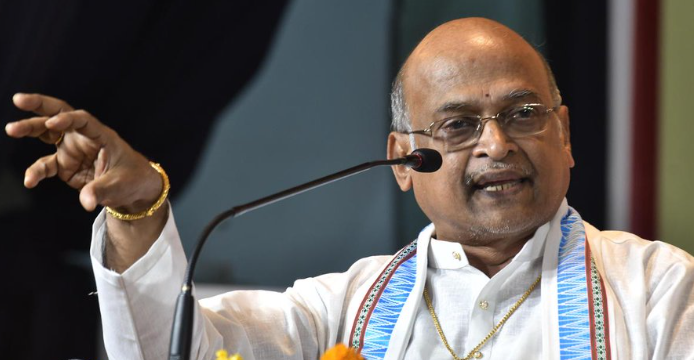
Ina video that spread rapidly across Telugu social media, Garikapati Narasimha Rao a Padma Shri awardee, celebrated orator, and spiritual luminary to millions, turned his rhetorical force against one of India’s most life changing welfare programmes.
He questioned why the government should provide meals, uniforms, and textbooks in schools, suggested students who wished to study should bring their own food from home, and crudely compared children who benefit from mid-day meals to “sobhanapu pellikodukulu” bridegrooms on the wedding night, implying they attend school only for the free food and not for learning.
The remarks have rightly drawn condemnation from across civil society, where several have called the comments incompatible with the realities of poverty that millions of Telugu families navigate daily. One must not only condemn his statement in anger, but in the firm conviction that public figures who command the trust of millions bear a responsibility to acquaint themselves with evidence before passing judgment on programmes that feed children who would otherwise go hungry.
What Garikapati Actually Said
To be precise about the controversy: Garikapati did not merely question the quality or administration of mid-day meals. He questioned the very premise why the government should feed children at all ? He argued that the state’s responsibility ends at providing quality education, and that material support like meals, uniforms, and textbooks exceeds that mandate. He further derided the inclusion of eggs in the Andhra Pradesh menu a nutritional intervention specifically designed to address protein deficiency among children from poor households, as unnecessary indulgence.
“Students who want to study can bring food from their homes. If they want to study, they can or else they can leave.” Garikapati Narasimha Rao said.
This statement reveals a fundamental misunderstanding of the material conditions in which poverty operates. For a child from a family earning below ₹5,000 a month, the question is not whether they want to learn. It is whether they can afford to send their child to school when that child’s labour in the fields, in households, on the streets, could mean the difference between a meal and none at all.
Children from poorer backgrounds are the most vulnerable to malnutrition, a condition that severely impacts their health, cognitive development, and educational outcomes. Malnutrition not only stunts physical and mental growth but also deepens social inequalities, leaving disadvantaged children further behind. A lack of essential nutrients during critical developmental stages can cause permanent deficits, limiting learning opportunities and future success, and perpetuating the cycle of poverty. The mid-day meal scheme was built precisely to address this problem.
When the YSRCP government came to power, one of the first things it looked at seriously was what children in government schools were actually eating. The annual expenditure for the mid-day meal scheme, known as ‘Jagananna Goru Muddha‘ in Andhra Pradesh, increased budget to ₹1,824 crore, compared to approximately ₹450 crore spent annually by the previous Telugu Desam Party (TDP) government.Not what the menu said. Not what the budget showed. What was actually landing on the plate.
What they found was not good enough so they changed it and Eggs were introduced four days a week a basic protein that nutritionists had been asking for years but that previous governments had kept deferring because of the cost. Seasonal vegetables replaced the same cheap fixed staples that had been rotated for years. In some districts, bananas and milk were added. The menu started to look like something a child might actually want to eat.
The Evidence Garikapati Ignored
This is not a matter of opinion. Decades of rigorous academic research including multiple peer-reviewed studies conducted specifically in Andhra Pradesh have established the Mid-Day Meal Scheme’s transformative impact on children’s lives.
A 2024 working paper by Cavapozzi, Fornasiero, and Randazzo from the Ca’ Foscari University of Venice analysed the impact of India’s Mid-Day Meal Scheme on the health and cognitive outcomes of school children, specifically in Andhra Pradesh. Employing a Heckman Selection Model to correct for self-selection bias a statistically rigorous approach, the study found a positive and consistent impact on both health and cognitive outcomes, regardless of whether children attended private or public schools. Crucially, the study found that the scheme helped reduce inequalities between children from different economic backgrounds, narrowing the learning gap between public and private school students.
This is the very inequality Garikapati’s remarks ignore: for the child whose parents cannot afford private schooling or a nutritious packed lunch, the mid-day meal is not charity — it is an equaliser.
Garikapati Narasimha Rao is not a politician. He is not required to defend policy. But he is a man with millions of followers, a Padma Shri conferred by the nation, and a platform that reaches into homes across two states. With that reach comes a responsibility that exceeds what is owed by the ordinary citizen the responsibility to verify before speaking, to understand before condemning, and to recognise the difference between a philosophical position on the role of the state and the empirical consequences of dismantling programmes that keep children in school and out of hunger.
Garikapati chose to question whether the children of the poor deserve to be fed at all while they learn. That is not a philosophical position. It is an indifference to suffering dressed up in the language of principle.
Conclusion: Evidence Over Eloquence
The Mid-Day Meal Scheme is not perfect. No programme of this scale can be. But it is, as the research unambiguously demonstrates, one of the most effective investments a state can make in its children’s futures. Every child who stays in school because of a free meal is a child who does not become a child labourer, a school dropout, or a statistic of poverty’s intergenerational grip.
The government of Andhra Pradesh should continue to strengthen, expand, and properly fund the scheme. Civil society should continue to hold it accountable for quality and equity. And public figures like Garikapati Narasimha Rao whose voice carries genuine weight should be responsible before speaking on matters where their eloquence exceeds their evidence.