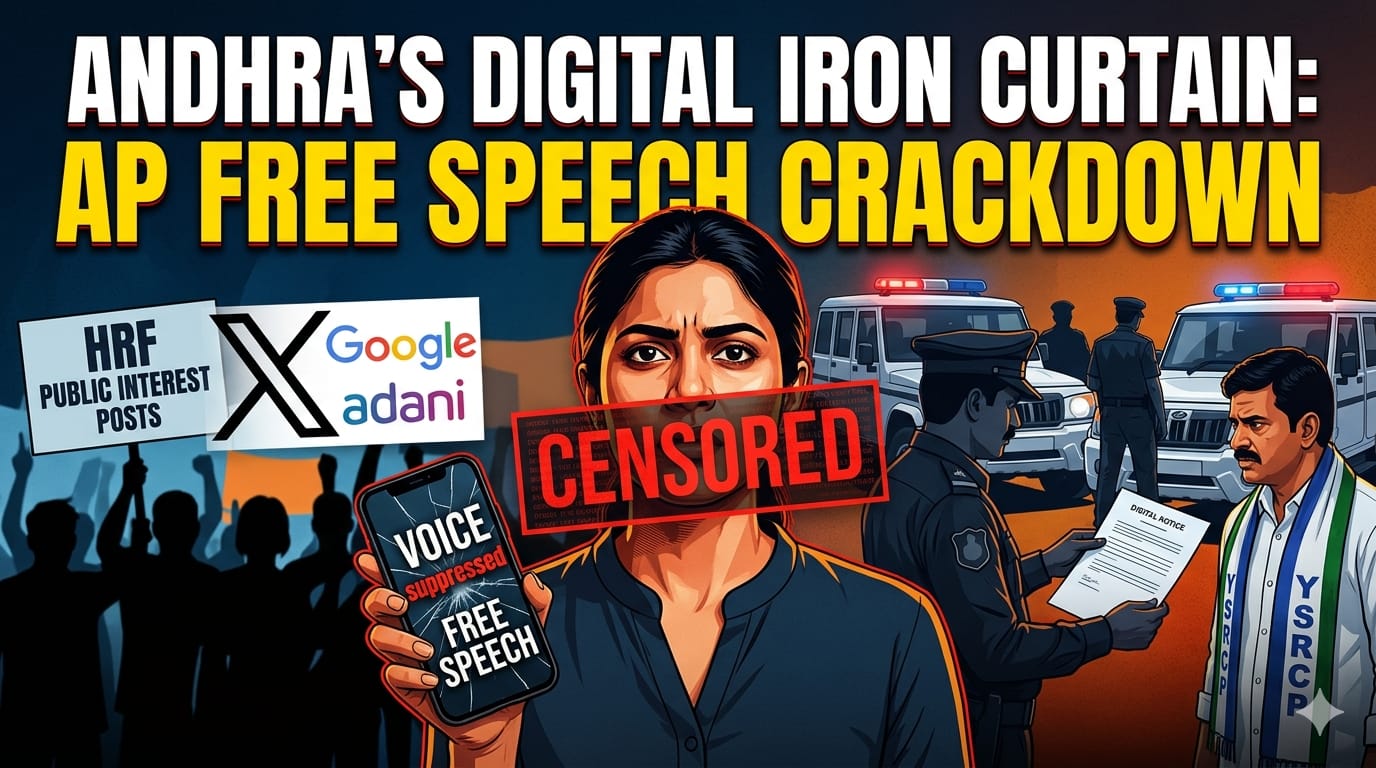
The digital landscape in Andhra Pradesh is witnessing a quiet but chilling transformation, one that strikes at the very heart of democratic dissent. Over the past few months, the political climate has turned increasingly hostile toward any voice that dares to question the ruling Telugu Desam Party (TDP) government. What was once a vibrant arena for civil society and opposition parties to demand accountability has rapidly devolved into a space governed by legal notices, restricted content, and forced digital silence.
The most alarming manifestation of this clampdown is the sudden and systematic erasure of public-interest advocacy from social media. As reported by The News Minute, the AP government has actively sought to restrict HRF social media posts against the Google-Adani data centre, signaling a deep-seated intolerance for independent oversight. Multiple critical posts by the Human Rights Forum (HRF) a respected civil society organization—were abruptly restricted on Instagram. These weren’t partisan attacks; they were data-backed critiques and public petitions questioning the environmental and social impacts of massive, state-backed mega-projects, including the Google-Adani hyperscale data centers in Visakhapatnam.
By weaponizing federal provisions like Section 79(3)(b) of the Information Technology Act, the state machinery is effectively outsourcing censorship to global tech giants. Meta complied with government directives to block these posts under the guise of handling “unlawful content,” yet the content in question merely raised legitimate questions regarding forest loss, land displacement of Dalit communities, and water safety near the Mudasarlova reservoir. If a democracy cannot question how its public resources are allocated to corporate giants, does freedom of speech exist in anything but name?
A Broad and Calculated Pattern of Silence
This is not an isolated bureaucratic glitch. It is part of a calculated, sweeping strategy to stifle criticism. Detailed investigations have highlighted how severe this digital block has become. As published by The Wire, an Instagram video on the villagers’ protest against the Visakhapatnam Google Data Centre was restricted following direct state intervention. The investigative media body Environmental Reporting Collective (ERC) saw its video journalism blocked within India just as it crossed 2.6 million views, simply for documenting the localized impact of data center expansions on marginalized communities.
When tech platforms attempt to maintain a shred of transparency, the fingerprints of regional law enforcement become undeniable. Platforms like X (formerly Twitter) have actively notified users and advocacy groups that they received formal requests from the Guntur Urban Police District to take down posts sharing public-interest petitions. While X has occasionally resisted summary deletion, the message sent to ordinary citizens is loud and clear: We are watching, and we will come after your digital footprint.
Two Fronts, One Strategy: The Blueprint of Digital Suppression
| Target | Core Action Taken | State Justification | Democratic Impact |
|---|---|---|---|
| Civil Society & NGOs (e.g., HRF) | Meta/X content restrictions, video takedowns, shadowbanning. | Regulatory compliance, preventing “unlawful content” under IT Act. | Erasure of environmental warnings and tribal displacement concerns from public view. |
| Political Opposition (e.g., YSRCP) | 680+ police notices, 147 cases registered, 49 physical arrests in a single week. | Curbing “defamatory” content, maintaining public order. | Complete chilling effect; systematically forces self-censorship through state harassment. |
The War on the Opposition’s Digital Footprint
While civil society faces censorship under the banner of regulatory compliance, political opponents are dealing with a much more aggressive onslaught. The government has taken its heavy-handed police machinery directly to the doorstep of the political opposition.
In a massive, coordinated sweep, the administration has systematically targeted the social media wing and sympathizers of the principal opposition party, the YSR Congress Party (YSRCP). As reported across national media, the Andhra government issued 680 notices, filed 147 cases, and arrested 49 people in a single week over digital posts. Senior leadership within the media wings—including high-profile coordinators like Pudi Srihari—have been detained, with their electronic laptops and personal devices seized under the pretext of ongoing investigations.
The strategy used against the opposition perfectly mirrors the pattern deployed against the HRF. Instead of countering political critique or policy questions with facts and open debate, the administration has deployed regional police forces to issue warnings, register criminal cases, and force immediate content deletion. This aggressive use of state power accomplishes a singular goal: it creates a massive “chilling effect.” When ordinary citizens see mainstream opposition members and grassroot activists getting slapped with police notices for an online post, they choose self-censorship over state harassment.
The Erosion of Democratic Accountability
In any healthy democracy, if the government believes public information is inaccurate, the correct response is to issue clarifications, present data, and engage the public. Retreating behind the shield of police notices, digital takedowns, and mass detentions signals a profound fear of public scrutiny.
The ongoing crackdown by the TDP government sets a dangerous precedent for Andhra Pradesh. By treating peaceful advocacy, environmental anxiety, and political opposition as threats to law and order, the state is steadily dismantling the constitutional guarantees of free speech. Secrecy cannot be the foundation of governance. If the administration truly believes in its development model, it must stop hiding behind the algorithmic shields of Meta and X, retract its heavy-handed police notices, and face the questions of the people it was elected to serve.