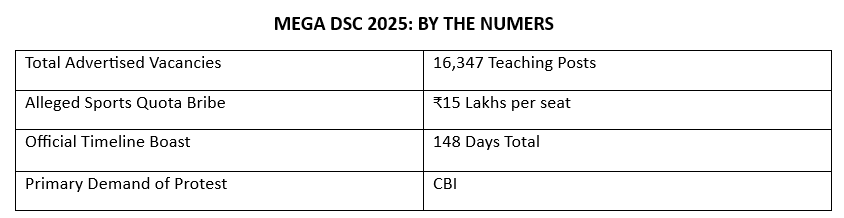
The grand administrative promise of the “Mega DSC 2025” teacher recruitment drive in Andhra Pradesh—championed by Chief Minister N. Chandrababu Naidu’s coalition government has violently unraveled into one of the most contentious public employment scandals in the state’s recent history. Designed to fill a staggering 16,347 teaching vacancies across the state, the massive public employment scheme was heralded by the administration as a historic triumph of governance, supposedly wrapped up in an unprecedented 148 days.
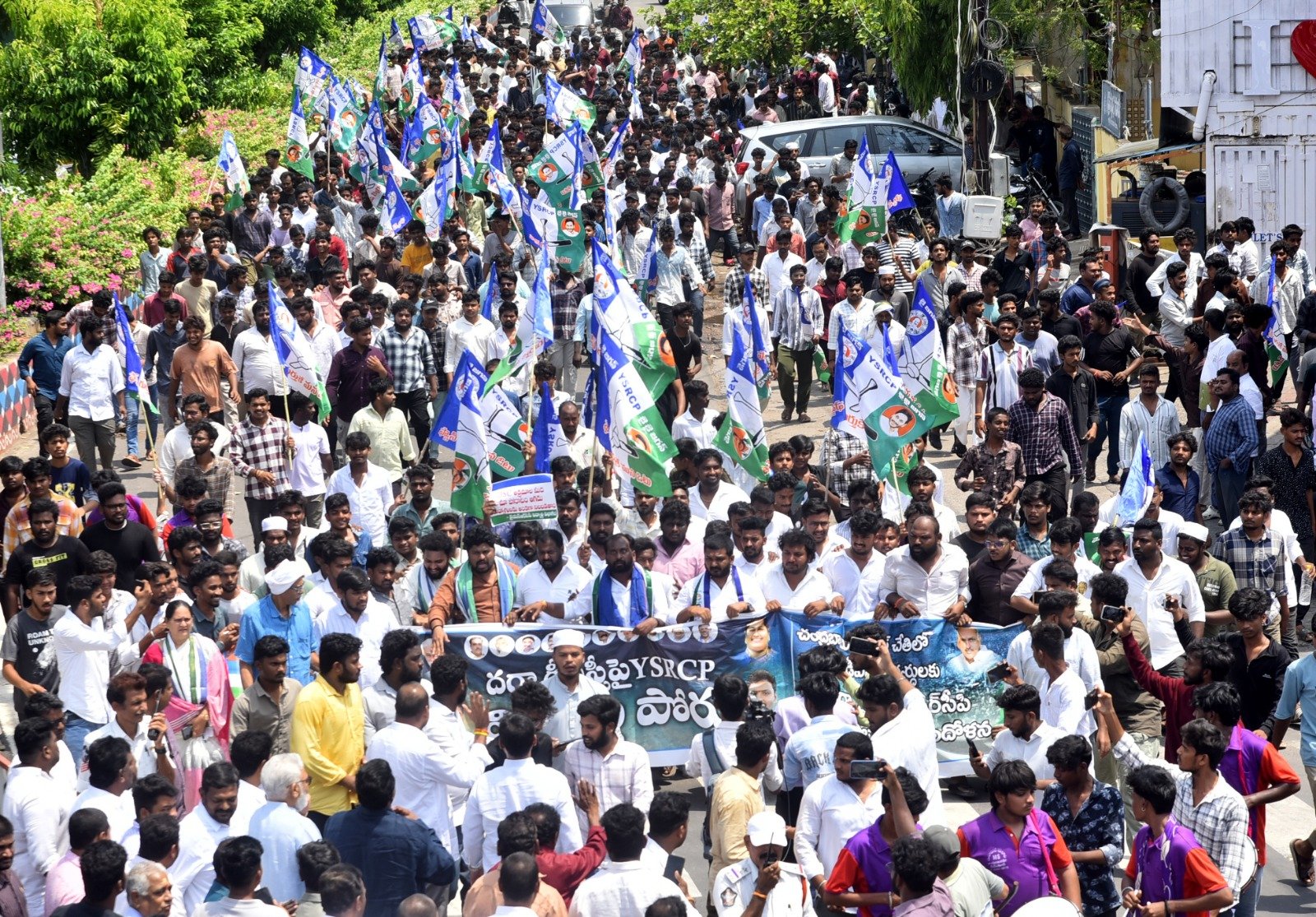
Instead, it has metastasized into a sprawling bureaucratic nightmare. A wave of aggressive state-wide protests has erupted, led by frustrated job aspirants, the YSR Congress Party (YSRCP), and major student coalitions including the Progressive Democratic Students Union (PDSU) and the Students’ Federation of India (SFI). The agitation has turned the spotlight squarely onto allegations of institutional corruption, systemic data manipulation, backroom job peddling, and an outright refusal by the state to honour its own merit lists. What was meant to be a lifeline for hundreds of thousands of unemployed youth has instead triggered a desperate crisis of faith in public institutions.
The Illusion of Efficiency: From ‘Mega DSC’ to ‘Mega Leak
When the Department of School Education fast-tracked the selection process for the AP DSC SGT and School Assistant positions, it bragged about an efficient, lightning-fast turnaround. However, investigative reporting and whistleblowers have revealed that this breakneck speed masked a devastating lack of procedural transparency.
Tens of thousands of highly qualified candidates, many of whom had spent half a decade studying around the clock for the District Selection Committee (DSC) examinations, woke up to find themselves entirely erased from the system. According to formal grievances raised across major districts like Guntur, Nellore, Tirupati, Prakasam, and Srikakulam, the state government altogether bypassed standard civil service transparency protocols.
Instead of publishing comprehensive, publicly verifiable district-level merit lists at local Collectorates or on open government portals, the administration opted to secretly notify selected individuals via automated SMS text messages.
This digital opacity effectively blindfolded the public. Eligible candidates who had achieved top ranks within their respective zones were suddenly left out in the cold. Even more damningly, several candidates who were officially issued formal call letters, and who successfully completed their mandatory physical certificate verifications, discovered that their names had inexplicably vanished from the final, official employment rosters.
Inside the Anomalies: Fraudulent Rankings and the Sports Quota Bazaa
The systemic rot plaguing the recruitment drive is highlighted by several high-profile scandals that the state government has struggled to contain, which are now being exposed by opposition leaders and student bodies alike:
- The SCERT Inside Job: In a particularly shocking revelation, an outsourced data entry operator working directly inside the State Council of Educational Research and Training (SCERT)—the very body intimately involved in administering the examination process—somehow secured the absolute first rank in the competitive examinations. Following an immediate, furious public backlash and allegations of an insider paper leak, the candidate’s name and performance data were quietly purged from the official database without a transparent inquiry.
- The Fake Sports Certificates: Deeper structural corruption has emerged surrounding the state’s traditional “Sports Quota” allocations. Opposition leaders and victimized job seekers allege that genuine regional athletes were systematically sidelined in favor of affluent buyers who purchased fabricated sports certificates from middlemen. These coveted government posts were reportedly auctioned off in private homes for sums as high as ₹15 Lakhs per seat.
“I was the district topper in the Scheduled Caste (SC) category for the School Assistant position in Srikakulam, yet I was denied my appointment,” says K. Anil Kumar, a devastated DSC victim. “Instead, they handed the post to an ineligible individual under the sports quota. When we formally challenged this, the administration simply put the post on hold rather than giving it to the rightful merit earner. For six months, the government has given us nothing but silence.”
A similarly tragic pattern occurred within the Secondary Grade Teacher (SGT) category. In multiple districts, candidates who held the top marks in their social reservation categories were displaced overnight. When they demanded answers, they discovered their positions had been filled by candidates with significantly lower marks under unverified quotas, or the posts were simply listed as “disputed” to freeze out the rightful winners.
A State in Revolt: Protestors Demand Judicial Accountability
The human toll of this administrative failure has spilled out from rural villages directly onto the tarmac of Andhra Pradesh’s major highways. Intense demonstrations have paralyzed regional hubs, including Guntur, Kakinada, Palnadu, and Anantapur. Outraged protestors, joined by student unions like SFI and PDSU, have gathered in front of iconic Dr. B.R. Ambedkar statues across the state, symbolically highlighting what they view as a direct assault on constitutional merit and social reservations.
The political pressure on the ruling alliance is reaching a boiling point. The YSRCP and student wing leaders are demanding the immediate resignation of the State Education Minister, Nara Lokesh, holding him personally responsible for overseeing what they label a “dark operation.”
The aggrieved candidates are not just demanding an internal review; they are explicitly calling for a comprehensive, independent probe by the Central Bureau of Investigation (CBI) to unearth the financial network behind the alleged job-selling racket.
The Bureaucratic Wall: Court Orders and Supernumerary Posts Ignored
For many, the ultimate tragedy lies in the state’s outright refusal to comply with judicial remedies. Dozens of disqualified candidates took the initiative to approach the High Court, successfully proving their credentials and securing explicit legal directives ordering the government to grant them employment.
In response, state officials reportedly deployed stall tactics, callously telling desperate job seekers that since the advertised vacancies were already technically filled, nothing further could be done.
While the High Court noted that the state holds the constitutional power to resolve such injustices by creating supernumerary posts to accommodate wrongfully displaced merit candidates, the Naidu administration has firmly balked at the financial commitment.
As the School Education Department scrambles to deflect blame by threatening defamation cases against critics, hundreds of thousands of aspirants across Andhra Pradesh are left watching their dreams of a stable teaching career slip away into an abyss of corporate-style cover-ups and political indifference.