NDA outside, Congress inside?
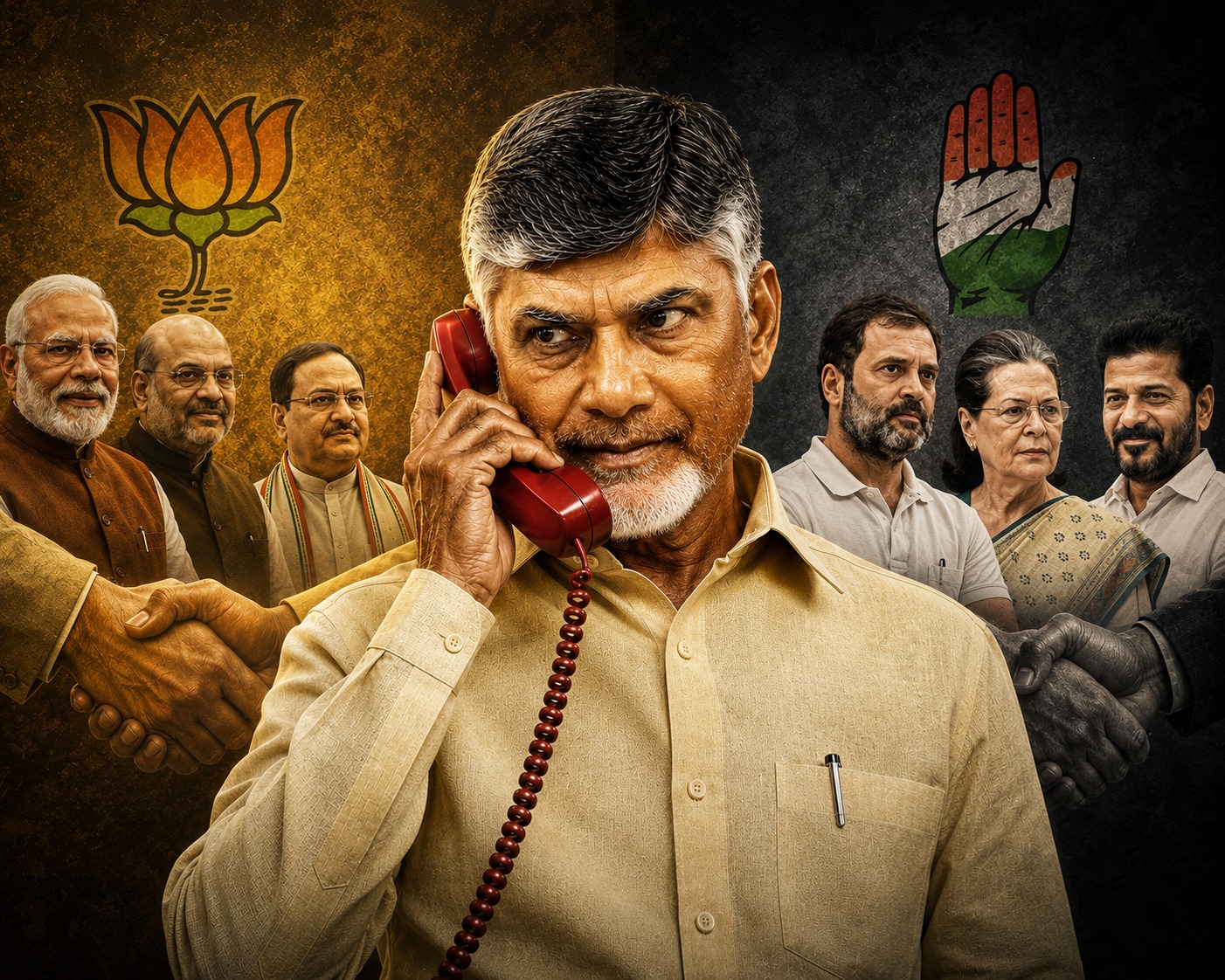
Even while remaining a key constituent of the BJP-led NDA at the Centre, Andhra Pradesh Chief Minister N. Chandrababu Naidu is increasingly being accused of maintaining a parallel political channel with the Congress leadership through Telangana Chief Minister Revanth Reddy. Political developments in recent months have reignited debate over what many describe as Chandrababu Naidu’s long-standing brand of opportunistic alliance politics.
The Telugu Desam Party was founded by N.T. Rama Rao as a political force against the Congress and the policies of Indira Gandhi. Critics argue that the very party built on anti-Congress foundations has now drifted into an uncomfortable political proximity with the Congress. They contend that Chandrababu Naidu, who took control of the party after sidelining NTR, has steadily moved away from the ideological principles on which the party was founded.
Recent events have intensified these discussions. During the unveiling of NTR’s statue at Maitrivanam in Hyderabad, Telangana Chief Minister Revanth Reddy made remarks that many interpreted as reflecting a close political understanding between himself and Chandrababu Naidu. Observers noted that while the event was organised under a Congress government, Telugu Desam Party flags and supporters appeared more visible than Congress workers. Similar questions had earlier emerged during political meetings in Khammam, where Revanth Reddy’s remarks were seen as unusually accommodating toward the TDP.
Political circles in both Telugu states are now discussing what is being described as Chandrababu Naidu’s “hotline politics” — maintaining formal ties with the BJP while simultaneously cultivating relationships with Congress leaders through backchannel political engagement. The perception has been strengthened by a series of interactions involving senior TDP leaders and Revanth Reddy in New Delhi.
During discussions surrounding the Women’s Reservation Bill, Congress opposed the legislation, yet TDP leaders were seen participating in political engagements alongside Revanth Reddy. Soon afterward, both senior TDP leaders and the Telangana Chief Minister attended a breakfast gathering hosted in Delhi by Union Minister Bhupathiraju Srinivasa Varma. The optics of these interactions generated considerable political speculation in national circles.
Questions have also emerged from recent Rajya Sabha seat-sharing discussions. Under the alliance arrangement, expectations were that the BJP and Jana Sena would each receive representation. However, Chandrababu Naidu’s reported reluctance to accommodate alliance partners created unease within the coalition. At the same time, Jana Sena chief Pawan Kalyan publicly questioned why BJP leaders remained silent when attacks were directed against him by political opponents.
Political observers also point to history. During the 2018 Karnataka elections, Chandrababu Naidu openly aligned with Congress leaders and shared platforms with Rahul Gandhi and Sonia Gandhi after years of opposing the party. That episode is frequently cited as evidence of his willingness to shift political alignments based on changing circumstances.
These developments have revived speculation that while Chandrababu Naidu continues to praise Prime Minister Narendra Modi and maintain his place within the NDA, he is simultaneously keeping communication channels open with the Congress leadership. As political equations in Delhi continue to evolve, questions are being raised about whether these connections are merely strategic engagements or preparations for future political realignments.
What remains undisputed is that the growing visibility of Chandrababu Naidu’s interactions, both direct and indirect, with Congress-linked political figures has sparked a fresh debate about the future direction of the Telugu Desam Party and the nature of its political commitments.