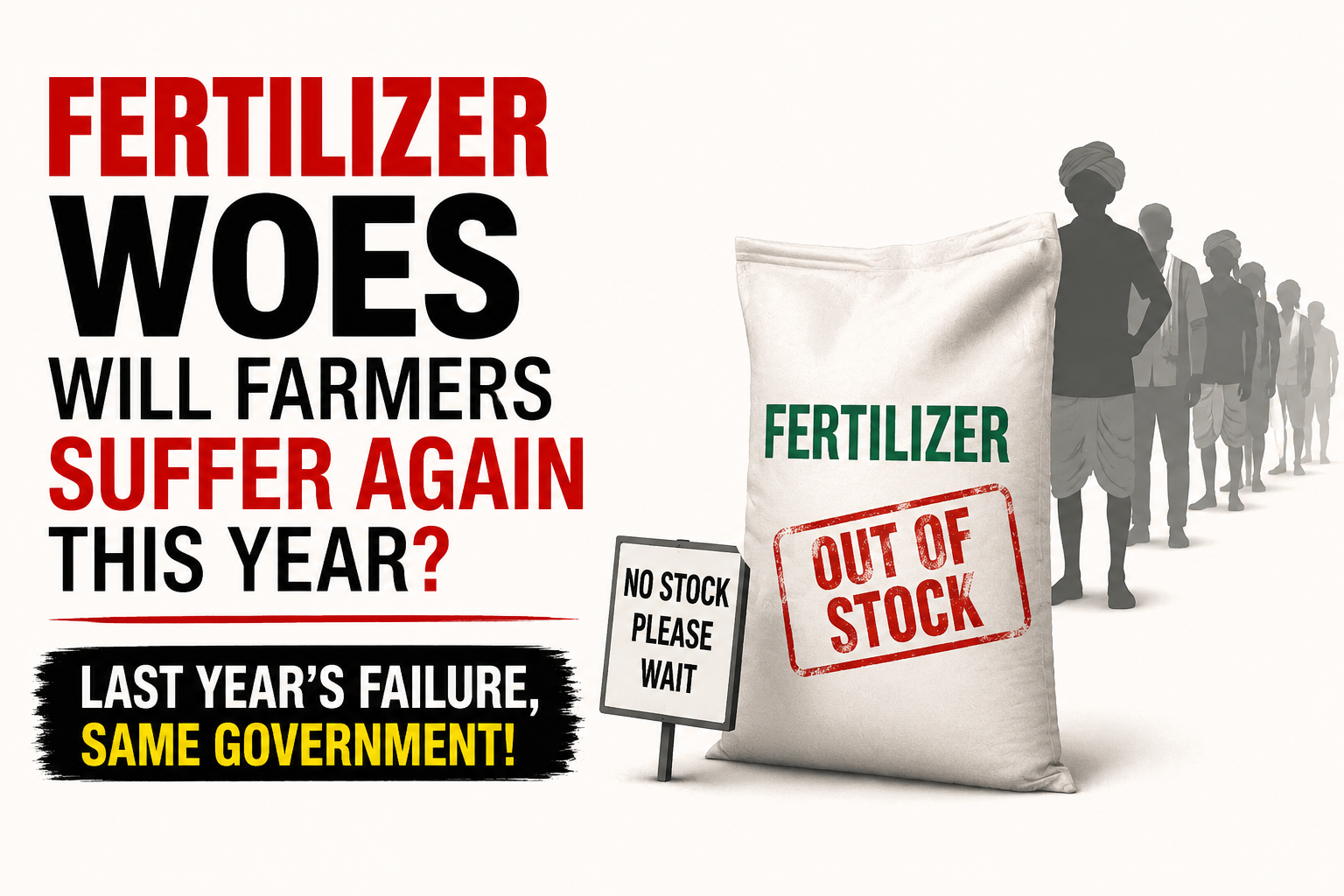
The Chandrababu Naidu government appears to be preparing to once again betray farmers on the supply of fertilizers and pesticides. Last year, farmers across Andhra Pradesh faced severe hardship due to shortages of fertilizers, especially urea and pesticides. Even after witnessing the suffering of farmers, the government has failed to learn any lessons and instead seems focused on covering up its failures through the support of yellow media propaganda.
The same government that failed miserably to ensure adequate fertilizer supply during the previous kharif season now appears to be heading toward an even worse crisis this year. Through selective media narratives, farmers are being mentally prepared for another shortage by creating stories that fertilizers are being diverted for other uses and that scarcity is unavoidable. As part of this exercise, a report titled “Summer Season… Where Are Fertilizers Going?” was published in Eenadu. Instead of exposing the government’s failures in fertilizer management or questioning its inability to control black marketing, sections of the yellow media are openly shielding the government and attempting to justify its administrative collapse, drawing sharp anger from the farming community.
During the last kharif season, farmers from Srikakulam to Anantapur struggled endlessly to obtain fertilizers and pesticides. Farmers stood in long queues for days outside PACS centres and private fertilizer shops under scorching heat and heavy rains. In several places, farmers left slippers, passbooks, and Aadhaar cards in queues while searching for shade. Elsewhere, clashes and pushing incidents broke out among farmers competing for fertilizer bags. Even in Agriculture Minister Atchannaidu’s own constituency of Tekkali, the situation remained the same. Despite this, the government denied any shortage and continued issuing misleading statements. Chief Minister Chandrababu Naidu defended the crisis using manipulated statistics, claiming fertilizer supply was equal to the previous year, and even advised farmers to reduce fertilizer usage instead of solving the shortage.
At the same time, fertilizers and urea bags supplied in limited quantities were diverted into black markets by TDP leaders in many areas, forcing farmers to buy them at double prices and increasing cultivation costs. In several places, fertilizers were sold only to those recommended by TDP leaders. In Telugu Rayapuram village of Kaluvayi mandal in Nellore district, three farmers were reportedly beaten by police for questioning the irregularities. In Saidapuram, farmers turned against PACS staff over favoritism toward coalition recommendations. In Jillella village of Gospadu mandal in Nandyal district, agricultural officers sold fertilizers only to those carrying recommendation slips from TDP leaders. In Jammalamadaka village of Palnadu district, farmers stopped the illegal diversion of fertilizer bags meant for them, after which TDP leaders allegedly attacked two farmers who recorded videos of the incident. Farmer Harinath Reddy sustained injuries in the attack.
YSRCP leaders continuously cornered the government over fertilizer shortages and organised protests demanding immediate solutions. However, the government initially dismissed the issue as opposition propaganda. Later, even TDP leaders and ruling party representatives admitted the seriousness of the crisis. Srikalahasti MLA Sudheer openly stated in the Assembly that urea had become a major problem and that farmers asking for urea were instead being forced to buy other fertilizer products.
In contrast, during the government of Y.S. Jagan Mohan Reddy, not a single farmer was forced onto the roads for fertilizers or pesticides. Through the RBK system, the government supported farmers from seed to sale by ensuring timely supply of fertilizers, seeds, pesticides, and gunny bags, while also procuring crops directly at RBKs. Agricultural scientists and experts were made available to guide farmers at every stage of cultivation. Advance planning ensured sufficient fertilizer stocks before every season, and strict measures prevented black marketing. That is why throughout five years of Jagan’s administration, farmers never had to stand in queues or suffer humiliation for basic agricultural inputs.