AMARAVATI Integrated Government Complex Cost Escalation
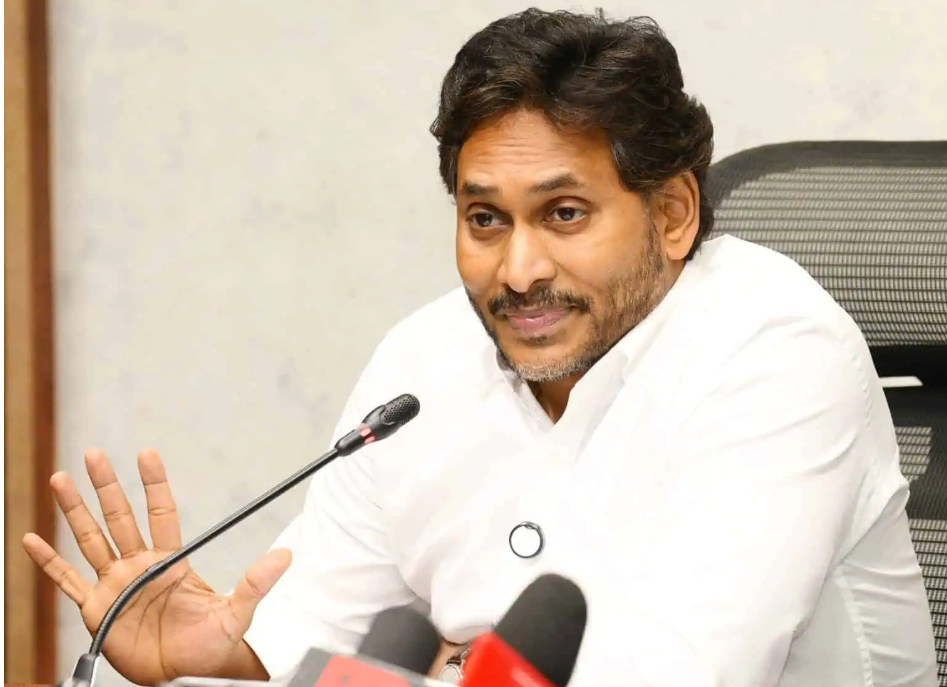
The centrepiece of former Chief Minister YS Jagan Mohan Reddy’s press conference was the Integrated Amaravati Government Complex — five towers to house the General Administration Department, the State Secretariat, and Head of Department offices. The Hindu had reported on it in April 2025. What Jagan did was strip away the architecture brochure language and expose the numbers underneath.
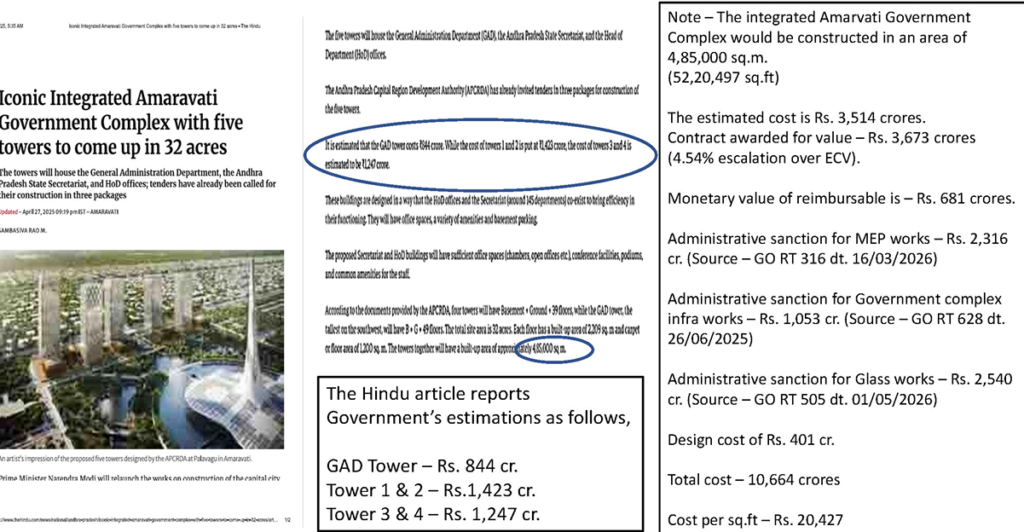
The government’s own GOs tell the story without ambiguity. The contract for the three packages was awarded through G.O.RT. No. 629 dated June 26, 2025 for a total of Rs 3,673.43 crore, a 4.54% escalation over the original estimated cost of Rs 3,514 crore, before construction had even begun in earnest. The three contractors awarded the work were M/s NCC Limited (GAD Tower — Rs 882.47 crore), M/s Shapoorji Pallonji & Co Ltd (Towers 1 & 2 — Rs 1,487.11 crore), and M/s Larsen & Toubro Limited (Towers 3 & 4 — Rs 1,303.85 crore).
But the base construction cost was only the beginning.
G.O.RT. No. 628 dated June 26, 2025 sanctioned an additional Rs 1,052.67 crore for roads, drains, water supply, sewerage, utility ducts, and avenue plantation. G.O.Rt. No. 316 dated March 16, 2026 sanctioned Rs 2,316.88 crore for MEP works for electrical systems, HVAC, fire protection, lifts, fire alarms, public address systems, and plumbing across all towers. G.O.RT. No. 505 dated May 1, 2026 added a further Rs 2,540 crore for glass, cladding, crown, atrium, canopy skylights, column cladding, PV panels, and building management units. Design costs added another Rs 401 crore.
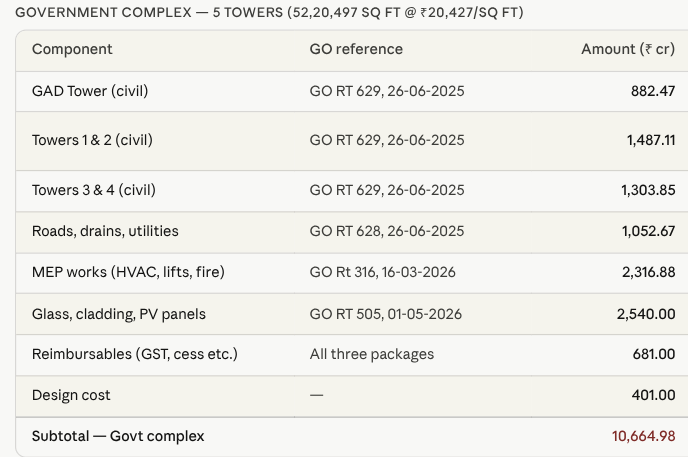
On top of all this, the aggregate reimbursable amount across all three packages seigniorage charges, MERIT levies, DMF contributions, NAC charges, and 18% GST, totalled Rs 681 crore.
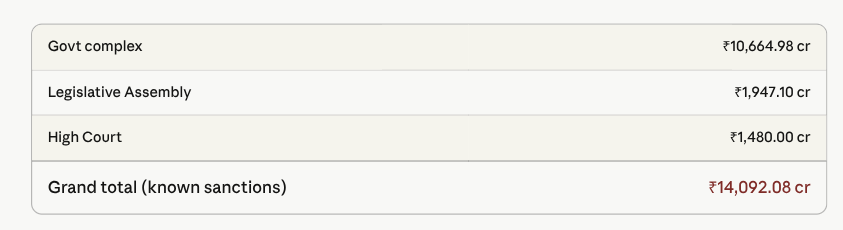
The grand total, as compiled from the government’s own administrative sanctions: Rs 10,664 crore. At a built-up area of 52,20,497 sq ft, the cost per square foot works out to an eye-watering Rs 20,427 more than luxury residential apartments in Hyderabad’s most premium localities.
For a government that claims fiscal austerity, this is not governance. It is self-indulgence sanctioned in official gazette notifications.
The Legislative Assembly and High Court — Rs 3,427 Crore More
The government complex was not the only monument under construction. Also includes the costs of the new Legislative Assembly building and the new High Court in Amaravati.
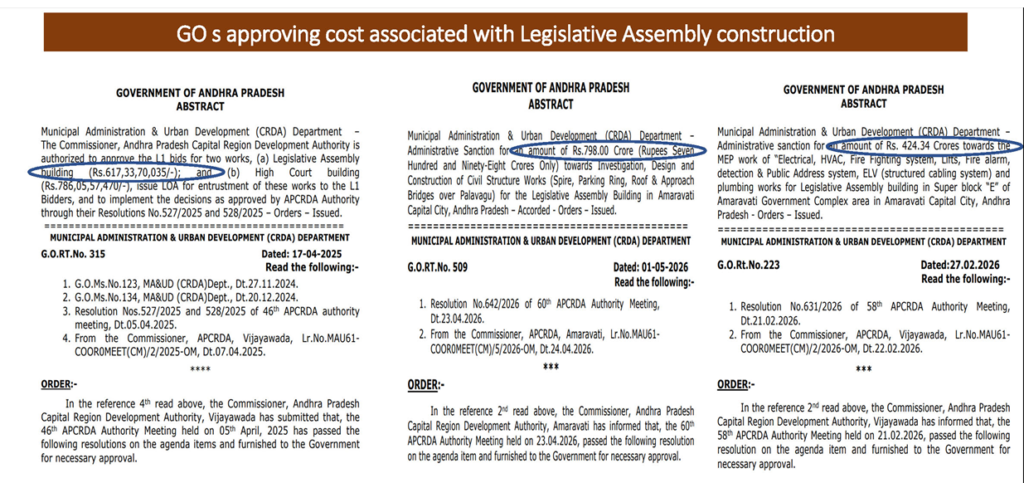
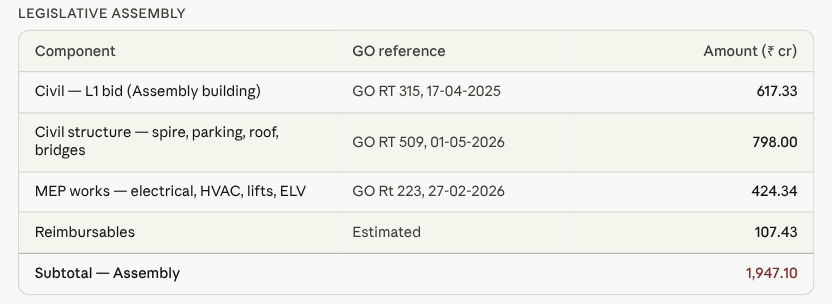
The Legislative Assembly alone has attracted three government orders: G.O.RT. No. 315 dated April 17, 2025 approved L1 bids of Rs 617.33 crore (Assembly building) and Rs 786.05 crore (High Court building). G.O.RT. No. 509 dated May 1, 2026 sanctioned Rs 798 crore for the civil structure works of the Assembly, including the spire, parking ring, roof, and approach bridges over Palavagu. G.O.Rt. No. 223 dated February 27, 2026 sanctioned Rs 424.34 crore for MEP works in the Assembly building alone.
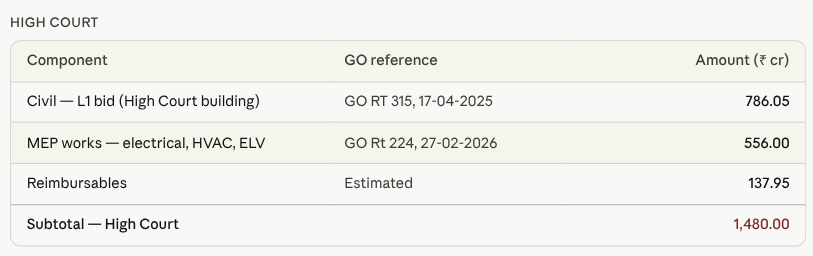
The aggregate for the Assembly across three GOs: Rs 1,839.57 crore in direct sanctions, rising to Rs 1,947 crore when reimbursables are added. For the High Court: Rs 1,342.06 crore in sanctions, rising to Rs 1,480 crore with reimbursables. And crucially, the presentation notes that these figures cover only tenders already issued — more tenders are yet to come for completion of both buildings.
The scale of capital spending in Amaravati, when aggregated, dwarfs every welfare commitment the government has broken. These are not investments that feed a single family, educate a single child, or treat a single patient.
Chapter Three: The Diesel Scandal — Buying Fuel for a Capital City at Retail Prices
One of the most extraordinary revelations in Jagan’s presentation was not about construction costs but about fuel. The Andhra Pradesh Capital Region Development Authority (APCRDA) required approximately 27,566 kilolitres of diesel for Amaravati construction works up to July 2026. The APCRDA’s Commissioner wrote to all heads of Oil Marketing Companies (OMCs) on April 24, 2026, requesting that they arrange for bulk diesel supply from nearby petrol bunks at retail prices.
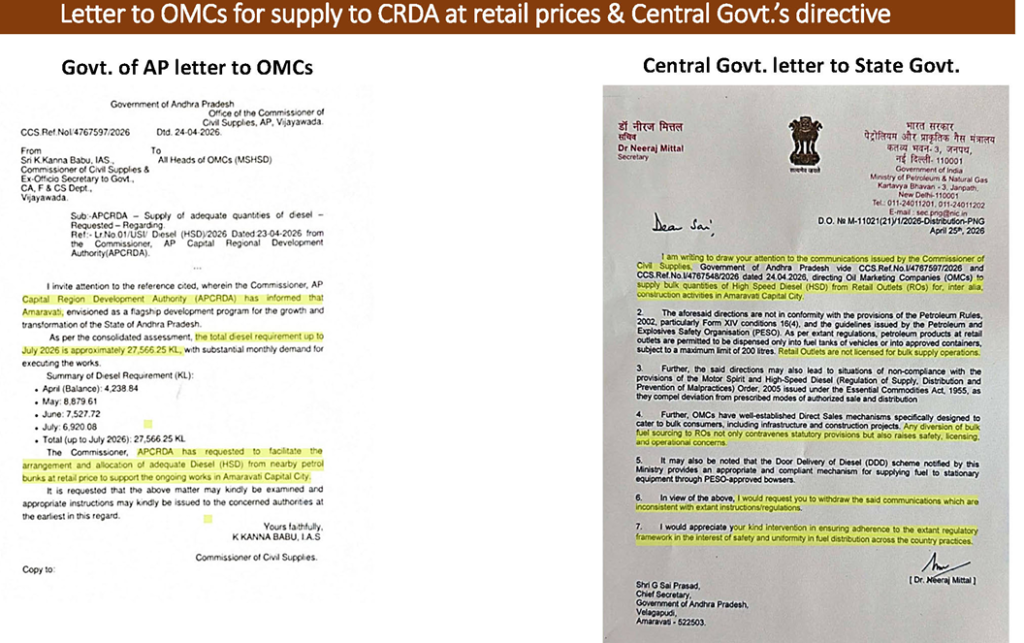
The Central Government’s response was swift and damning. Dr. Neeraj Mittal, Secretary of the Ministry of Petroleum and Natural Gas, wrote to the Chief Secretary of Andhra Pradesh on April 25, 2026, pointing out that the APCRDA’s directions were not in conformity with the Petroleum Rules 2002, guidelines from PESO, or the Essential Commodities Act 1955. Retail outlets, the Secretary clarified, are not licensed for bulk supply operations. The Central Government asked AP to withdraw the communication.
The implication is profound: the Chandrababu government was attempting to bypass established bulk fuel procurement channels and divert retail pump supplies to its own capital city construction, creating shortages for ordinary consumers and violating statutory provisions — in its desperate rush to show visible construction progress before the next election cycle.
Chapter Four: 6.23 Lakh Pensioners Deleted
The most quietly devastating slide in the entire presentation was a simple comparison of two numbers.
In March 2024, under the YSRCP government, social welfare pensions were being paid to 66,34,372 beneficiaries across all categories — old age, widows, disabled, single women, weavers, fishermen, Dappu artists, traditional cobblers, ART patients and dozens of other vulnerable groups, all receiving Rs 3,000 to Rs 10,000 per month.
In May 2026, under the Chandrababu government, the same pensions are being paid to 60,11,293 beneficiaries.
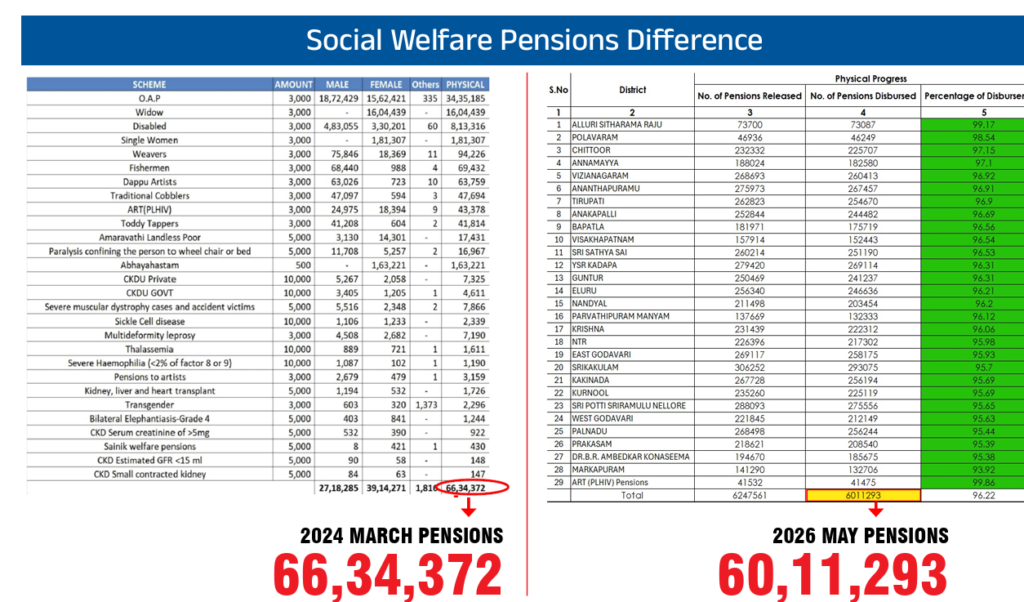
The difference: 6,23,079 people more than six lakh individuals have been dropped from the pension rolls. These are not savings. These are elderly men and women, widows, disabled citizens, and the chronically ill, who have been quietly removed from a list they depended on for survival, while the government sanctioned Rs 2,540 crore for glass cladding on a government tower.
No official explanation has been offered for this deletion of 6.23 lakh beneficiaries. No public hearing was held. No rehabilitation plan was announced. They were simply removed, their names struck from a database, their Rs 3,000 monthly lifeline cancelled in the same weeks that government orders were being signed for atrium canopies and PV panels in Amaravati.
The Promises That Vanished After the Ballot
Jagan’s presentation also documented the NDA alliance’s 2024 election manifesto the “Prajagalam” which had explicitly promised to control petrol and diesel prices in Andhra Pradesh. The manifesto, bearing the signatures and photographs of both Chandrababu Naidu and Pawan Kalyan, carried the promise in bold: We will control petrol and diesel prices.
The presentation then placed alongside it the actual GO dated February 5, 2015 — from Chandrababu’s previous term — which had increased VAT on petrol from 31% to 31% + Rs 4 per litre, and diesel from 22.5% to 22.5% + Rs 4 per litre. A further cess of Rs 1 per litre was added in September 2020 under YSRCP for road development — but Chandrababu’s 2015 tax hike remained the structural base.
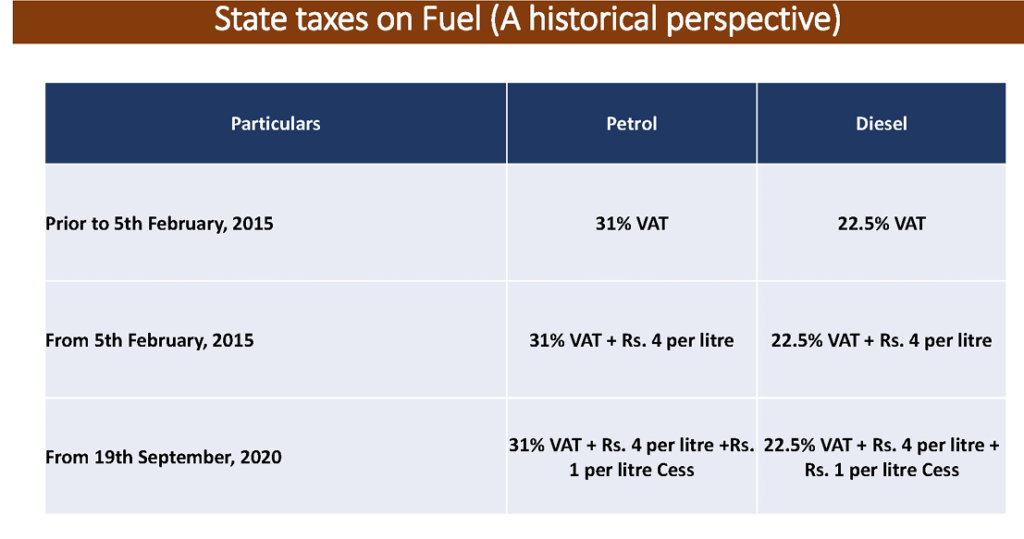
The TDP’s manifesto promise to control fuel prices was made against this backdrop of its own track record of hiking them. Voters were promised relief. What they received was silence on fuel prices and a Rs 10,664 crore secretariat complex.
Similarly documented was the “Babu Guarantee” bond — a formal written commitment signed by Chandrababu Naidu and Pawan Kalyan promising benefits starting June 2024, including Rs 1,500 per month for women, Rs 20,000 per year for farmers, and pension from age 50 for BC, SC, ST, and Muslim minority communities. The presentation showed a filled-out guarantee card promising annual assistance of Rs 1,04,000 and five-year total assistance of Rs 5,20,000 to a beneficiary family. Two years later, these remain largely unfulfilled promises.
Conclusion: Towers of Glass, Walls of Silence
The Chandrababu Naidu government will argue that Amaravati is investment in Andhra Pradesh’s future, that the capital city will generate employment and growth, that construction of institutions is the foundation of a modern state.
But the Rs 24 crore per kilometre cost of building a National Highway — cited in a February 2026 Lok Sabha answer by Union Minister Nitin Gadkari — provides a useful benchmark. For the Rs 10,664 crore being spent on five government towers, the state could have built 444 kilometres of four-lane national highway connecting every underserved district in Andhra Pradesh. It could have funded Matsyakara Bharosa for 21 years. It could have restored every deleted pension for over four years.
These are choices. Every government order signed, every GO sanctioned, every crore allocated is a choice about whose life matters and whose does not. The Chandrababu government has made its choices visible — in glass and steel rising over Amaravati, and in the silence of 6.23 lakh homes where a pension no longer arrives.
YS Jagan Mohan Reddy’s press conference on May 21, 2026 did not merely present an opposition critique. It presented a government’s own paperwork as its indictment. The documents speak. The question is whether the people of Andhra Pradesh are listening.