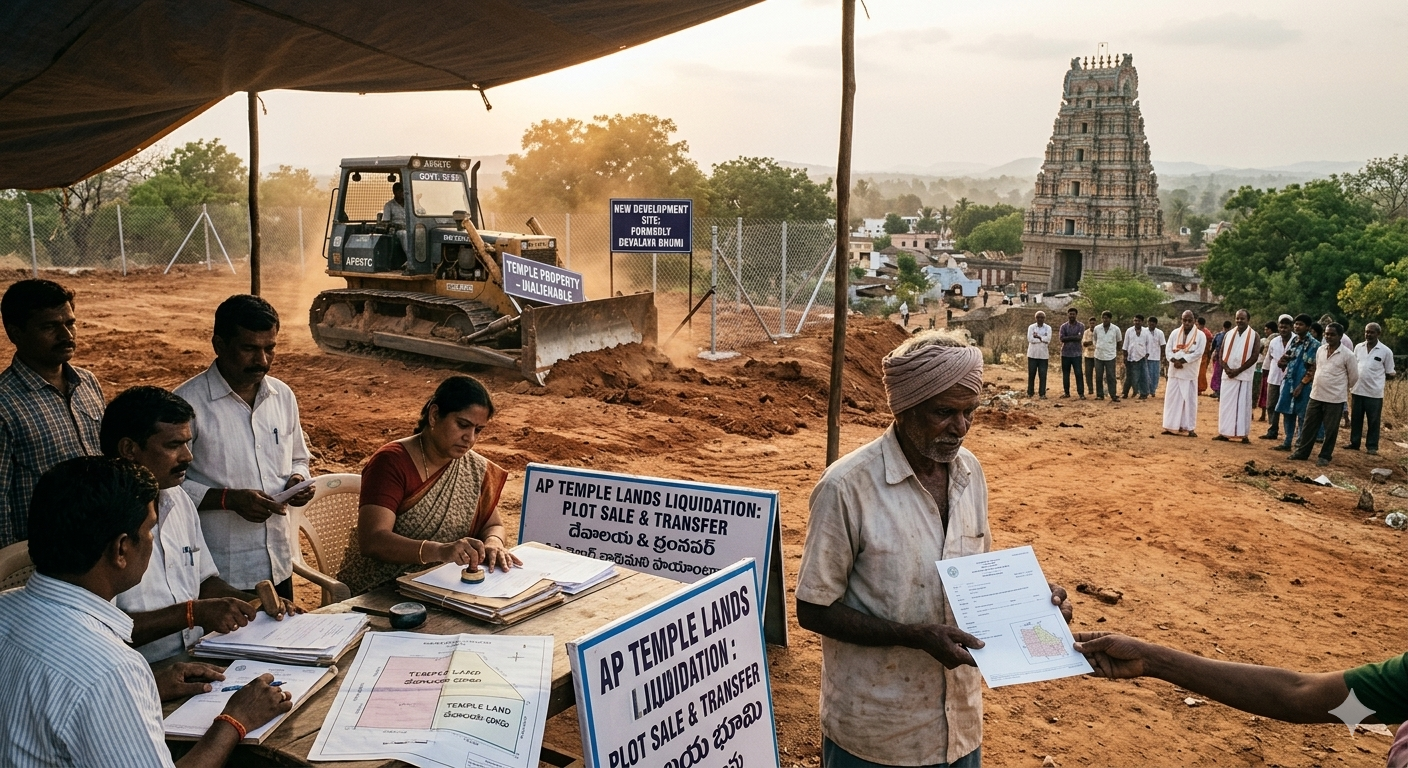
May 19, 2026, the Andhra Pradesh Government issued G.O.RT. No. 789 under the Revenue (Endowments II) Department, a quiet but deeply significant order that has sparked outrage among religious and civil society groups across the state.
The order grants formal permission for the sale of 6.89 acres of land belonging to Sri Pushpagiri Mutt, Vallur Mandal, Kadapa District, specifically Survey No. 259 of Kalluru Agraharam Village, Garladinne Mandal, Ananthapuramu District through e-tender-cum-public auction, invoking Section 80 of the Andhra Pradesh Charitable and Hindu Religious Institutions and Endowments Act, 1987.
The government order states that the Commissioner of Endowments (FAC), A.P. Vijayawada, reported the circumstances and, after “careful examination,” the government accorded permission for the sale. The official justification, highlighted in the order itself, is that the land “has become uneconomical and vulnerable to repeated encroachments.”
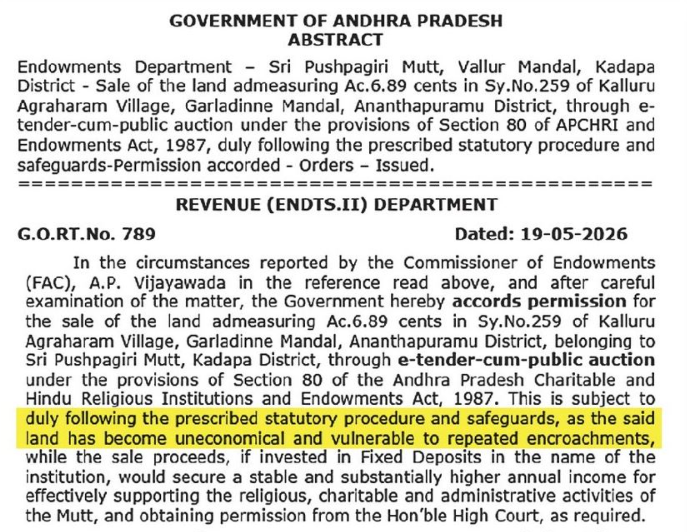
The government further argues that if the sale proceeds are invested in Fixed Deposits in the name of the institution, it “would secure a stable and substantially higher annual income for effectively supporting the religious, charitable and administrative activities of the Mutt.”
The sale, the order adds, is subject to obtaining permission from the Hon’ble High Court, as required under the provisions of the Act.
The Pushpagiri Connection
Sri Pushpagiri Mutt is attached to the historic Pushpagiri Temple Complex in Kadapa District.The Mutt holds considerable land endowments across the region, meant to fund the spiritual and charitable activities of the institution in perpetuity. The land in question — 6.89 acres in Ananthapuram district’s Kalluru Agraharam village is part of this ancient endowment inheritance.
The Chandrababu Naidu-led government has been systematically permitting the sale of endowment lands across the state within just 40 days of the government itself informing the Endowments Commissioner’s office of the situation.
Critics point out that the state’s total endowment land portfolio, officially calculated at 4.67 lakh acres, is under increasing threat. Opposition parties and Hindu religious organisations allege that this approach, framed as “protecting” temple properties from encroachment, is actually a mechanism to convert sacred land into liquid assets, with proceeds that may not always reach the institutions they are meant to serve.
The report further alleges that while strong laws exist to prevent encroachments on endowment lands, the government is choosing the path of sale rather than enforcement raising the uncomfortable question: why protect the land from encroachers by selling it to the highest bidder?
Several endowment properties are reportedly being transferred to private entities under the guise of leases, with land records being altered from agricultural classification to commercial. Urban temple lands are reportedly being leased to private organisations for 33 years as per G.O.-189. In Krishna district, land belonging to a temple in Gudivada is reportedly being eyed for development in Vijayawada’s Gollapudi area. In Kakinada, land belonging to the Sri Bhavanarayana Swamy temple is allegedly being allocated for a cricket stadium.
Devotees and legal experts are watching closely whether the Hon’ble High Court, whose permission is still required, will act as the last line of defence for Andhra Pradesh’s temple lands.