Rayalaseema has always been defined by what it lacks. While the Krishna and Godavari rivers course through Andhra Pradesh, carrying billions of cubic feet of water to the sea, the four districts of Rayalaseema Kurnool, Kadapa, Anantapur, and Chittoor have watched from a distance. Droughts come regularly. Crops fail quietly. Farmers leave silently. The region has one of the lowest irrigation coverages in the entire state, and for generations.
The river that flows past them
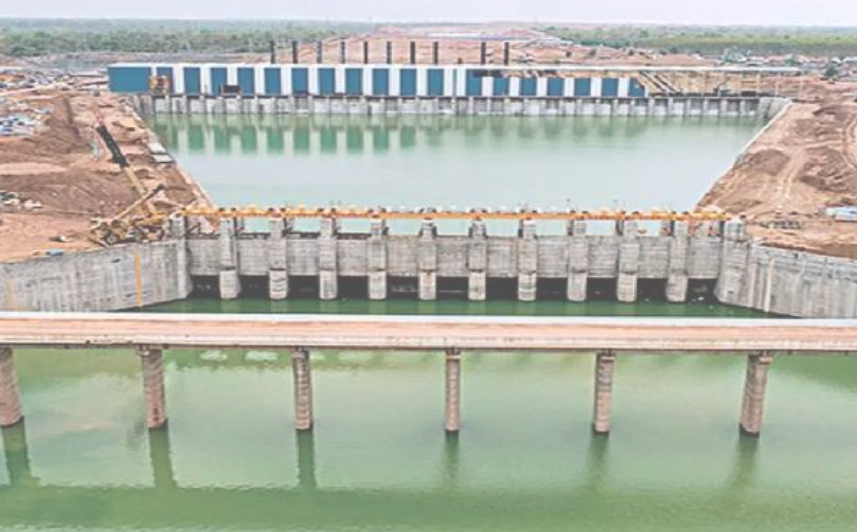
Stand at the Pothireddipadu Head Regulator on the Krishna river and watch the water. During the monsoon months July, August, and September the Srisailam reservoir fills. The water level climbs. At 800 feet, it begins to touch the intake points for the canals that serve Rayalaseema. At 841 feet, modest flows become possible, at 881 feet the regulator can draw 44,000 cusecs i.e 4 TMC per day enough to transform the landscape.
But here is the tragedy that the people of Rayalaseema have lived for decades. Srisailam reaches 881 feet only during flood seasons, and only briefly. For most of the year, the water sits below 800 feet. When the water is there, it is not drawn efficiently. When the rains finally come and the reservoir fills, Telangana opens its left bank power station, generates electricity, and releases the water downstream past Nagarjunasagar, past Prakasam Barrage, and into the Bay of Bengal. Rayalaseema watches the water pass.
In 2016–17, 337.95 TMC of water came to Srisailam. Of that, Rayalaseema received only 67.44 TMC through the right bank power station. The rest flowed away. In 2015–16, when the right bank power station should have discharged 58.69 TMC to Rayalaseema, only 0.95 TMC actually reached. Less than two percent and the rest was gone.
This is the river that flows past Rayalaseema. This is the wound that has never healed.
The man who mortgaged the water
Before we understand the rescue, we must understand the betrayal that made the rescue necessary.
In 2014, after the state was bifurcated and Andhra Pradesh lost Hyderabad, N Chandrababu Naidu came to power. He came with promises a new capital, a new Singapore, a new beginning. What he quietly did with water was the opposite of a new beginning. It was a surrender.
The Krishna waters dispute between AP and Telangana was raw and urgent. Telangana’s KCR government began building illegal lift irrigation schemes Palamuru-Rangareddy and Dindi without Krishna Board approval, without allocation, drawing from a shared reservoir that AP depended upon. Telangana took over the Srisailam left bank power station, the Nagarjunasagar right canal head regulator, and the Pulichinthala left bank power station all of them assets that either belonged to AP or were shared. It generated power, released the water downstream, and let it flow to the sea rather than to AP’s canals and Chandrababu said nothing.
At the APEX Council meeting on September 21, 2016, convened by Union Water Resources Minister Uma Bharati in response to pressure from Rayalaseema farmers who had approached the Supreme Court when every other stakeholder was fighting for their water AP CM Chandrababu Naidu did not ask for Palamuru-Rangareddy and Dindi works to be stopped. He did not press AP’s case. He did not object to Telangana’s illegal draws.
Why? The documents are direct: because Chandrababu was caught in the vote-for-note case, colluding with then-Telangana TDP leader Revanth Reddy. To escape that case, he needed Telangana’s protection. The price of that protection was Rayalaseema’s water.
He changed the alignment of Rayalaseema projects. He shifted command areas away from Krishna-based sources. He mortgaged the state’s rights over the Krishna river rights that farmers, engineers, and governments had fought for across generations, to maintain a political arrangement that served himself.
When the man who was supposed to protect Rayalaseema’s water is the same man who gave it away, the people of Rayalaseema have nowhere left to turn. Until 2019.
The pipe that was finally laid
On May 5, 2020, YS Jagan Mohan Reddy stood before the cameras and announced what Rayalaseema had waited decades for the Rayalaseema Lift Irrigation Scheme.
The design was elegant in its ambition and precise in its engineering. The scheme would lift 3 TMC of water per day from Srisailam at the 800-feet level during flood flows, when the water was there through the Pothireddipadu Head Regulator, into the Srisailam right bank main canal, and from there to Rayalaseema, Nellore, and Prakasam districts. It would supply drinking water to millions, including, through the connected systems, to Chennai. It would protect crops in the Teluguganga, Galeru-Nagari, KC Canal, and SPNSS command areas covering 12.9 lakh acres.
The total cost: Rs 3,850 crore. Modest, by the standards of Indian infrastructure. Transformative, by the standards of Rayalaseema’s history.
The engineering rationale was sound. Srisailam need not be at 881 feet for this scheme to work. The lift was specifically designed to capture water during the flood season — the months when the reservoir fills fast, when Telangana races to generate power and release downstream — and divert it into Rayalaseema before it could escape. It was a scheme designed around the reality of how the river actually behaves, not how planners wish it would.
The Pothireddipadu Head Regulator’s capacity was upgraded from 44,000 to 80,000 cusecs. The Handri-Neeva scheme’s capacity was raised from 3,850 to 6,300 cusecs. Contracts worth Rs 3,307.6 crore were awarded. Rs 795 crore of foundational work was completed. Sub-canals in Rayalaseema were restored. Galeru-Nagari works moved forward. Farmers in Anantapur, Kurnool, and Nellore watched, cautiously, as the pipes were laid.
Then the government changed.
The silence of Revanth’s friend
On January 3, 2026, Telangana CM Revanth Reddy stood in the Telangana Assembly and said something remarkable. He said that when he met AP CM Chandrababu Naidu privately, Chandrababu himself had told him to not to worry about the Rayalaseema Lift. He had shown Revanth Reddy the honour his words of stopping the Rayalaseema Lift Irrigation works.
He is not accused of inaction. He is not accused of negligence. He is accused, by the testimony of his own political ally, of actively working to kill Rayalaseema’s water scheme as a favour.
The Chandrababu government’s behaviour since coming to power in 2024 fits this accusation point by point. The Environmental Appraisal Committee meeting was convened on February 27, 2025. The government sent officials who, in the meeting, did not make proper arguments for environmental clearance. They did not present the technical case. They did not push back. The committee, lacking a credible government defence, directed the works to be stopped temporarily.
In any normal government, when an Expert Appraisal Committee raises clearance questions, the Chief Minister’s office mobilises engineers, legal teams, and technical experts to make the strongest possible case. Clearance is fought for. It is argued in committee rooms, escalated to ministerial level, and presented with data and precedent.
The Chandrababu government sent officials who said nothing of consequence. The works stopped. And the government did not appeal. It did not protest. It did not even publicly question the stoppage. The water, as always, continued to flow past Rayalaseema.
While Rayalaseema waits, Telangana builds
Here is the bitter arithmetic of what is happening simultaneously, while AP’s government ensures the Rayalaseema Lift remains stalled.
Telangana’s Palamuru-Rangareddy and Dindi lift irrigation schemes have no water allocation. They draw from Srisailam and Nagarjunasagar the same reservoirs from which Rayalaseema’s water is meant to come. The NGT ruled in 2021 that these schemes must be stopped and imposed a Rs 920.85 crore fine on Telangana in 2022 for defying that order. Telangana simply absorbed the fine and continued building.
The Chandrababu government has not pressed the NGT case. It has not demanded enforcement of the fine. It has not approached the Supreme Court to compel Telangana’s compliance. It has not raised the issue at the APEX Council.
Meanwhile, the Krishna Board’s jurisdiction, delineated by notification in July 2021 under YS Jagan’s government which brought the Nagarjunasagar right canal regulator, Sagar Spill Veil 22 gates under state control is not being actively enforced by the current government. The institutional gains made to protect AP’s water rights are being quietly allowed to erode.
At Srisailam, during the flood season, when the water level rises and the opportunity exists the Pothireddipadu Head Regulator, with its upgraded capacity sitting idle, Telangana’s left bank power station hums. The water is drawn, power is generated, and the flow moves downstream. The expanded capacity of the Handri-Neeva scheme 6,300 cusecs, raised at considerable cost by the previous government, sits waiting for an operational order that the current government shows no urgency to issue.
Above 800 feet at Srisailam, AP has the right to lift 6.95 TMC per day. Currently, the state is capturing barely 0.33 TMC per day through Handri-Neeva. The gap between what AP is entitled to and what it is taking is not an engineering problem. It is a political choice. And the political choice, made in private conversations between two chief ministers, is costing Rayalaseema millions of acre-feet of water every monsoon season.
The farmers who gave their land, and got silence
In the villages near the Pothireddipadu Head Regulator, the farmers who were supposed to benefit from the scheme are watching. Some of them let their fields lie fallow, waiting for the water that was promised. Some of them have heard that environmental clearance is pending a phrase that has become, in Andhra Pradesh’s irrigation history, a synonym for indefinite delay.
They know the history. They know that the Chandrababu government itself, between 2014 and 2019, implemented the Inni Papireddy and Atma Reddy irrigation schemes without environmental clearance. They know the Champaiwat scheme was built without clearance and was handed permission by the YWML in 2021. They know that environmental clearance, when the political will exists, can be pursued aggressively and obtained. Pratipadu scheme Rs 24.56 crore, Parlakimidi scheme Rs 24.9 crore — these were tendered and worked on by the previous government without waiting for clearance, under the understanding that engineering necessity and administrative process can move together.
They know that the current government’s argument that works must wait for clearance is not a principle. It is a preference. When the preference is to build, clearance is pursued. When the preference is to stall, clearance becomes an excuse.
In Muppavaram, Gadimalla, and Ayyavaripalle villages in Anantapur district, the Handri-Neeva scheme works were stayed following a court case engineered with the help of Janasena in Chennai. Farmers in those villages, who had already seen the infrastructure begin to take shape, watched as the stay order froze the site.
They do not have the vocabulary of water rights tribunals. They do not know the allocations decided by the Bachawat Tribunal 512 TMC to AP, 299 TMC to Telangana. They do not know what the Krishna Board’s jurisdiction notification of July 2021 means in legal terms. They know what they can see: the canal, half-built. The pump house, incomplete. The water, still flowing past.
What 881 feet means, and what it does not
The government’s defenders will argue that the Rayalaseema Lift is impractical because Srisailam rarely reaches 881 feet, and that the scheme was designed around conditions that don’t reliably occur. This argument sounds technical. It is actually dishonest.
The scheme was not designed around the assumption that Srisailam would be at 881 feet continuously. It was designed specifically to capture water during the flood season, the weeks when the reservoir does fill, when water does pour in from both the Krishna and its tributaries, when without intervention, the water would flow past and be lost. A lift irrigation scheme that works for 30, 40, or 60 days during peak flood flow is not a failed scheme. It is a precisely targeted intervention.
The Pothireddipadu Head Regulator at its upgraded 80,000-cusec capacity can draw 4 TMC per day when Srisailam is above 881 feet. Even at 854 feet, 7 TMC is available. Even at 841 feet, 2 TMC can be transferred. The scheme was built to be useful across a range of levels, not only at maximum capacity.
More importantly, when Srisailam is below 841 feet, not a single drop flows through Pothireddipadu anyway, with or without the lift scheme. The lift adds capacity at higher water levels and captures what would otherwise be lost. It costs nothing when the water is not there. It delivers everything when the water is.
To call this an impractical scheme is to misunderstand or deliberately misrepresent what it was designed to do.
The Almatti silence, the Upper Bhadra silence, the Polavaram surrender
The Rayalaseema Lift is not the only water crisis the Chandrababu government is failing to address. It is simply the most visible.
Karnataka has been moving to raise the height of the Almatti dam on the Krishna river upstream. Each foot added to Almatti reduces the water available downstream to Andhra Pradesh. The Chandrababu government has not formally opposed this move. It has not written letters. It has not raised objections at the appropriate water tribunals.
The Upper Bhadra project in Karnataka threatens the water flows into the Anantapur district. The Chandrababu government has ignored its impact no objections filed, no inter-state negotiations demanded, no protective legal action taken.
The Polavaram project the lifeline of north coastal Andhra and the tribal areas of the Godavari was reduced in height from 45.72 metres to 41 metres under the current political arrangement with the Centre, effectively converting it from a full-fledged irrigation reservoir into a barrage. A barrage stores no water. It diverts flow but cannot hold it against the river’s seasonal variability. The loss of irrigation potential from this single decision will be felt across decades and across millions of acres.
Three water crises. Three silences. One government.
The water does not wait
The monsoon does not care about electoral cycles. The Krishna river does not pause for political arrangements between chief ministers. Every flood season that passes without the Rayalaseema Lift operational is a season of water lost permanently drawn away by Telangana’s power stations, drained through Prakasam Barrage, swallowed by the Bay of Bengal.
Rayalaseema’s farmers cannot wait another five years. The crops they are not growing now are not simply delayed but they are cancelled. The families leaving for cities because their land cannot be irrigated are not on holiday they are displaced permanently. The water that flows past this season cannot be recalled next season.
The scheme exists. The contracts were signed. Rs 795 crore of work is complete. The upgraded regulators are built. The expanded canal capacity is ready. The only thing missing is a government that wants to turn it on.
Instead, Rayalaseema has a government that privately promised a rival state’s chief minister that it would not turn it on. A government that sends officials to environmental committee meetings to say nothing. A government that watches Telangana defy NGT orders, absorb a Rs 920 crore fine, and continue building and does not raise a voice.
The people of Rayalaseema have heard the word soon in every language that Telugu politics offers. They have heard it from every party, at every election, in every promise. They have learned, painfully, that soon in the language of irrigation policy means never unless someone fights for it every single day, in every committee room, in every court, in every inter-state negotiation, against every arrangement that trades their water for someone else’s political survival.
The Rayalaseema Lift Irrigation Scheme is not a YSRCP project. It is Rayalaseema’s water and every day it stays switched off, it is being stolen not by an enemy, but by a government that was elected to protect it.