Government policies on private investment must serve the public interest. Land allotments for investment should be conducted through competitive and transparent processes that ensure maximum public benefit.
The inauguration of Inorbit Mall on March 22, in Vizag developed under a Build–Operate–Transfer (BOT) model, has sparked fresh debate, with many drawing comparisons between the Inorbit deal and the LuLu Mall allotment. BOT Model is generally seen as a balanced model that brings private investment without surrendering public ownership, while a 99-year lease hands over public land for generations with little accountability.
Back in 2018, under then Chief Minister Chandrababu Naidu’s Telugu Desam Party government, UAE -Based Lulu Group was allotted 13.83 acres of prime land located very next to the RK Beach area in Visakhapatnam to develop a five-star hotel, a mall and a convention centre.
But what drew the most public attention was the manner in which the deal was structured. Around 13 acres of prime land then valued at nearly ₹50 crore per acre was allotted at a throwaway price of just ₹4 lakh per acre on a 99-year lease through a single-bid process. This pricing, far below even conservative market estimates, became the central controversy in the years that followed. While the rental value of the land allotted to Lulu is almost Rs 50 crores per month but it was given at a throw-away price of Rs 7.02 crores per month, causing a huge loss to the state revenue.
When Y.S. Jagan Mohan Reddy swept to power in 2019 with a historic majority, his government moved swiftly to undo what it viewed as corrupt land deals made by his predecessor. The Lulu deal was near the top of the list.YSRCP government decided to cancel the land allotment made to the Lulu Group for the Visakhapatnam project. The state cabinet, chaired by CM Jagan, cancelled the Government Order issued by the previous TDP government allotting 13.83 acres of land .
After the scrapping of the agreement with the Lulu Group, the Raheja Group agreed in principle to set up Andhra Pradesh’s first Inorbit Mall on a piece of land provided by the Visakhapatnam Port Authority on a Build-Operate-Transfer (BOT) basis.
The distinction matters enormously. BOT is a model where a private party builds and operates an asset, then transfers it back to the government after a fixed period. It is considered far more protective of public assets than a 99-year lease after which the government gets the asset back, not the private entity.
The Raheja Group proposed to lease the 17-acre land for a period of 30 years on a BOT basis, for which the Vizag Port Trust quoted ₹125 crore as an upfront payment. Andhra Pradesh then chief minister Y S Jagan Mohan Reddy laid the foundation stone for the ₹600 crore Investment by the K. Raheja Corporation’s Inorbit Mall at Visakhapatnam.
Public Land – Two completely different approaches:
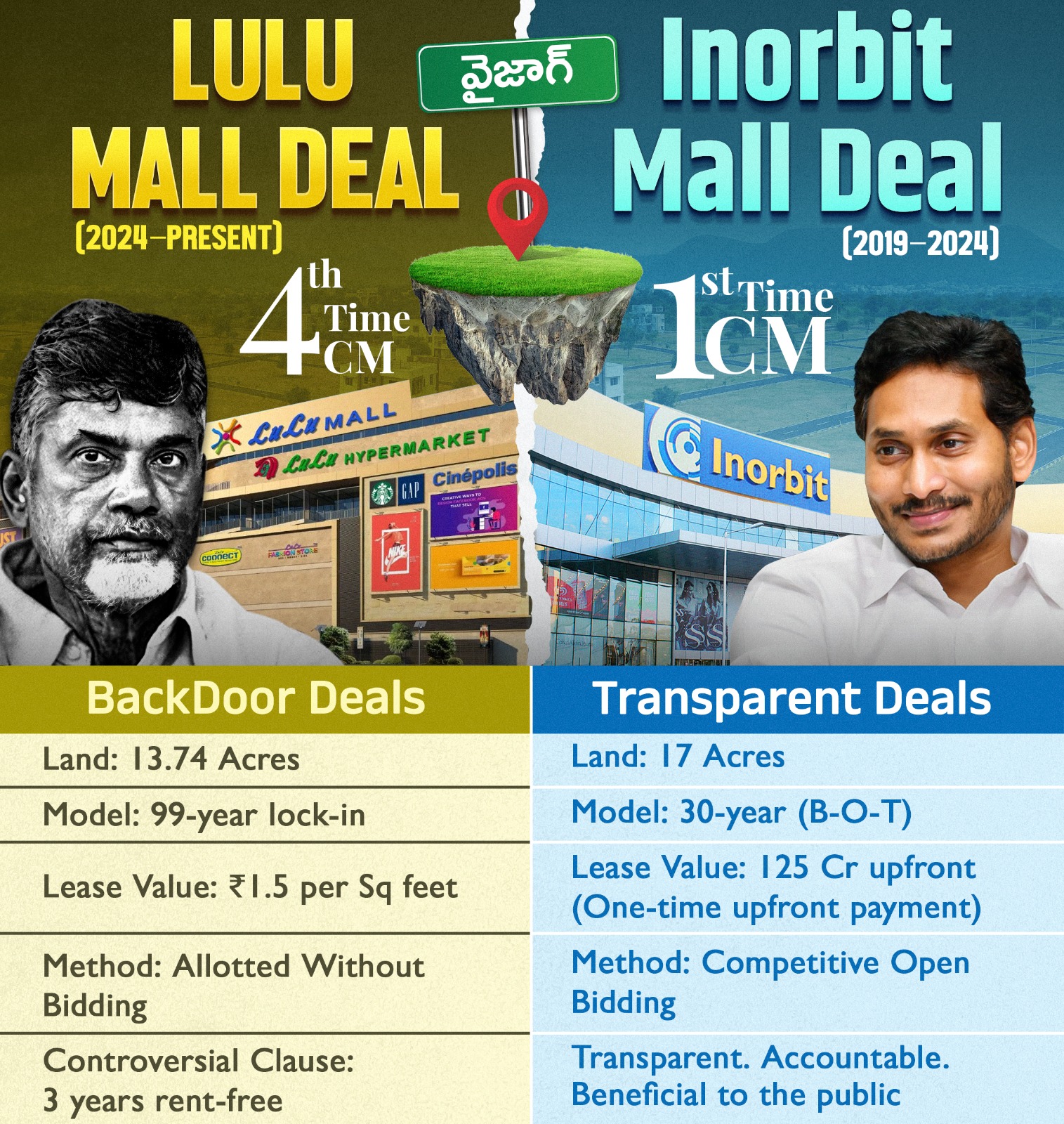
A comparison between the Telugu Desam Party–Lulu deal (2024–Present) and the YSR Congress Party–Inorbit deal (2019–2024) highlights two fundamentally different approaches to public asset management.
While the LuLu deal involves 13.74 acres leased for 99 years, effectively granting long-term control over public land, the Inorbit project was structured under a 30-year Build–Operate–Transfer framework, ensuring that ownership ultimately reverts to the government.
The contrast becomes sharper in financial terms. The Inorbit deal secured ₹125 crore upfront, reflecting a monetisation approach aligned with market benchmarks. In comparison, the LuLu deal is reported at approximately ₹1.5 per sq. ft, raising questions about valuation and public revenue realization.
Equally significant is the process. The Inorbit project followed a market-linked Port Trust mechanism, whereas the LuLu allotment is noted as being made without competitive bidding, limiting transparency and price discovery. Additional concessions further widen the gap. The LuLu deal reportedly includes a three-year rent-free period, while no such concession was extended in the Inorbit case.
The Return of Lulu — and the Return of the Old Terms:
The 2024 election brought Chandrababu Naidu back to power and almost immediately, the Lulu Group which vowed never to invest in Andhra Pradesh is now back.
In September 2024, Lulu Group Chairman and Managing Director Yusuffali met CM Naidu to discuss restarting investments, describing their relationship as 18 years of brotherhood. The projects discussed included an international-standard shopping mall in Visakhapatnam with 8 IMAX screens, hypermarkets, logistics, and food processing centres in other parts of AP.
By March 2025, the Chandrababu Naidu-led government issued orders restoring 14 acres of land at Harbour Park on RK Beach Road to the Lulu Group International, reviving the long-pending project. The State Investment Promotion Board, chaired by Naidu, gave its formal clearance.
Lulu sought and received exceptions where the land was allotted on a lease basis for 99 years, rent was to be exempted for three years or until the shopping mall opened (whichever came earlier), and rent would increase by only 10 per cent every 10 years.
In May 2025, a Public Interest Litigation filed by Paka Satyanarayana prompted the Andhra Pradesh High Court to issue notices to the state government regarding land allocations to the Lulu Group, especially in Visakhapatnam. The PIL questioned the transparency of these allocations and alleged procedural irregularities.
Lulu Expansion: Vijayawada’s RTC Land and the Mallavalli Deal
The Visakhapatnam land was just the beginning. The TDP government extended its Lulu largesse across the state. In Vijayawada, the government leased 4.15 acres of land belonging to the Governorpet depot. The site of the old bus stand in the heart of the city to Lulu for developing a mall. In Mallavalli, Krishna district, the TDP government leased 7.48 acres to Fair Exports, a Lulu subsidiary, for a food processing unit at just ₹50 lakh per year for 66 years, with rent increasing by only 5% every five years, instead of the standard 10% every three years.
The Deeper Question :
Andhra Pradesh is still rebuilding after bifurcation without Hyderabad’s revenue engine, still constructing a capital, and under constant pressure to attract big ticket investments. But urgency cannot become an excuse for undervaluing public assets.
The Lulu deal exposes a critical truth: attracting investment is not the same as protecting public interest. It raises a harder question—when a cash-strapped state offers deep concessions, who is really making the sacrifice?
When prime beachfront land, decades-old public assets like bus depots, and fertile agricultural land in Krishna district are handed out on 66- to 99-year leases at what critics call throwaway prices, it is not just a policy choice; it is a transfer of public wealth into private hands.