The southern states of India Andhra Pradesh, Karnataka, Tamil Nadu, Telangana, and Kerala together form one of the most economically vibrant regions in the country. Their Goods and Services Tax (GST) collections serve as a powerful barometer of economic activity, consumer demand, and the effectiveness of tax administration. The data for January and February 2026 tells a compelling story: a region that is not only growing strongly against the backdrop of the previous year but is also navigating the month-on-month rhythms of India’s fiscal calendar with remarkable resilience.
KEY FINDING: The five-state South India bloc collectively collected ₹24,995 crore in February 2026, a marginal improvement of +1.5% over January’s ₹24,625 crore, defying the national trend of a 5% month-on-month decline.
The National Backdrop
Before zooming into the south, it is essential to understand the national backdrop. India’s gross GST collection in February 2026 stood at ₹1,83,609 crore, a significant 8.1% jump year-on-year compared to ₹1,69,779 crore in February 2025. That headline number, however, masks a month-on-month contraction. January 2026 had been a blockbuster month at ₹1,93,384 crore while the February figure represents a 5.1% pullback.

This is not unusual. February is structurally a shorter month, and GST collections often reflect post-January settlement activity. What makes the February 2026 data noteworthy is the strength of the year-on-year performance, which signals that India’s underlying consumption engine remains robust. Against this national canvas, the southern states painted a picture that was at once familiar and strikingly differentiated.
The South India Story :
The five southern states collectively mobilised ₹24,995 crore in post-settlement GST in February 2026, compared to ₹24,625 crore in January 2026 — a net positive swing of ₹370 crore, or +1.5%. This contrasts sharply with the national MoM dip of 5.1%, signalling that southern India’s consumption and compliance dynamics are operating on a different, more resilient plane.
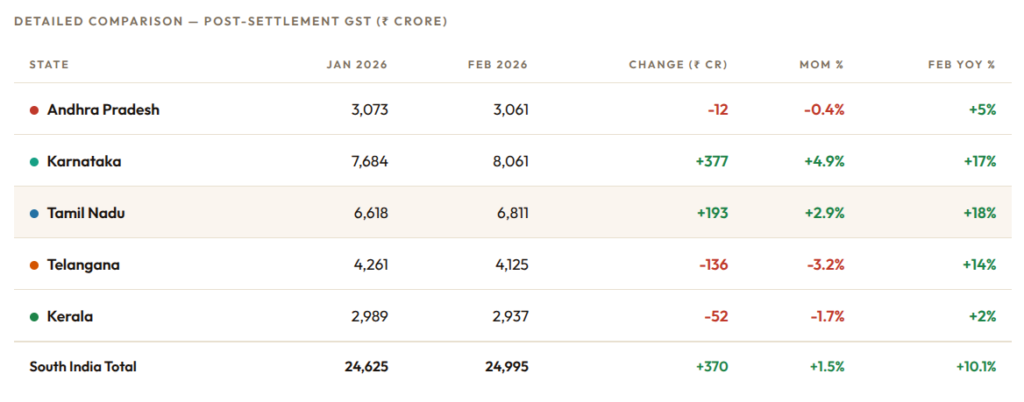
Cumulatively, the south’s year-on-year performance for February 2026 versus February 2025 averaged a healthy +10.1%, underscoring not just a monthly blip but a sustained structural upswing in economic activity across the peninsula.
State wise Details:
Karnataka: The Frontrunner
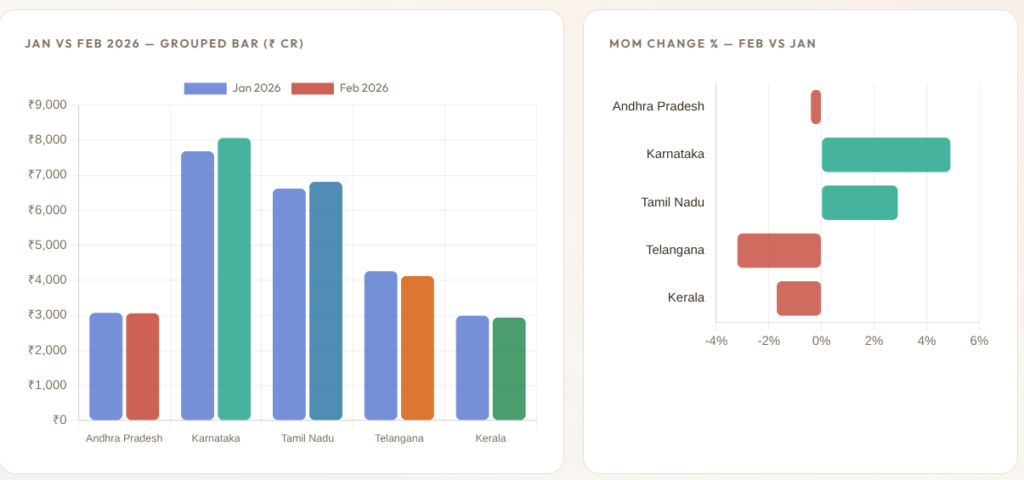
If February 2026 belonged to any single state, it was Karnataka. The IT capital of India powered its way to ₹8,061 crore in post-settlement GST up a commanding +4.9% from January’s ₹7,684 crore, and a remarkable +17% above February 2025’s levels. Karnataka stood as the largest GST contributor among the five southern states.
Bengaluru’s thriving technology ecosystem, high-value services exports, a rapidly expanding startup economy, and some of the highest per-capita consumption patterns in peninsular India all converge to make Karnataka’s GST engine extraordinarily powerful.
Tamil Nadu: The Consistent Performer
Tamil Nadu followed closely behind with ₹6,811 crore in February 2026, an improvement of +2.9% over January’s ₹6,618 crore. More impressive is the state’s year-on-year growth of +18% the highest YoY jump among all five states, and the strongest validation of Tamil Nadu’s manufacturing and services revival.
From automobiles and auto-components to textiles, leather goods, and electronics manufacturing, the state draws GST from a highly diversified economic base. The combination of a resilient manufacturing sector recovering from post-pandemic supply chain disruptions and a growing services hub in Chennai has propelled Tamil Nadu to its highest YoY growth rate among its southern peers. For policymakers and analysts alike, the +18% year-on-year signal is one of the most encouraging datapoints to emerge from the south in recent months.
Telangana: A Momentary Step Back
Telangana’s February 2026 collections came in at ₹4,125 crore, a pullback of -3.2% from January’s ₹4,261 crore. On face value, this is the sharpest month-on-month decline among the five states. Yet context matters enormously here.
Year-on-year, Telangana’s February 2026 collections are +14% above February 2025 a strong structural growth trajectory. The MoM dip is better understood as a natural reversion following an exceptionally strong January, rather than any underlying weakness. Hyderabad’s pharmaceutical clusters, IT campuses, and manufacturing ambitions continue to power the state’s fiscal engine.
Andhra Pradesh: Steady and flat
Andhra Pradesh recorded ₹3,061 crore in February 2026, virtually unchanged from January’s ₹3,073 crore a marginal -0.4% month-on-month movement and remained flat.
The year-on-year comparison tells an even more compelling tale. February 2026 represents a +5% improvement over February 2025, achieved despite a structural reduction in the tax rate base. For 11 consecutive months from April 2025 to February 2026, net GST collections have surpassed the same month in the prior year .
Kerala: Modest
Kerala closed February 2026 with ₹2,937 crore in post-settlement GST, a modest -1.7% decline from January’s ₹2,989 crore. Of all five states, Kerala’s MoM movement was the most contained, and its year-on-year growth of +2% while the lowest in the southern region reflects a state economy that is structurally different from its neighbours.
Kerala’s economic model is uniquely oriented around remittances, tourism, and services rather than heavy manufacturing. This makes it inherently less sensitive to industrial production cycles but also less exposed to the high-volume GST contributors that drive the Karnataka or Tamil Nadu numbers. The +2% YoY growth, while seemingly modest, represents consistent positive momentum in an economy that has been recalibrating post-COVID, with tourism receipts recovering and retail consumption on a gradual upswing.
Conclusion:
The story of South India’s GST collections in January and February 2026 is ultimately a story of a region that is punching above its weight in India’s fiscal landscape. Five states with five distinct economic personalities.
Karnataka leads with ambition. Tamil Nadu leads with industry. Telangana recovers with confidence. Andhra Pradesh steadies, Kerala climbs with patience. Together, they form a southern fiscal ecosystem that is increasingly mature, increasingly compliant, and increasingly consequential in India’s national GST narrative.